July reinforced our convictions on companies positioned to benefit from artificial intelligence (AI), despite the marked underperformance of US technology stocks at the beginning of the month, as a result of investor concerns about the monetisation of AI-related investments.
The earnings season provided compelling evidence: the conversion of AI-related spending into revenues is becoming increasingly visible, while sector fundamentals remain solid, supported by strong earnings momentum across key segments of the AI ecosystem. These developments confirm our preference for companies best positioned across this value chain and support our decision to maintain structural exposure to the theme in portfolios.
We continue to see a market driven by both earnings and investor sentiment, against a backdrop of persistent volatility and demanding profitability expectations. Selectivity remains key: we combine structural exposure to growth themes with systematic, option-based strategies (QIS) designed to generate income and help mitigate the impact of market volatility, while maintaining a balanced risk allocation.
Inflationary pressures caused by the energy shock in the first half of the year are moderating. The peak in inflation is probably behind us and, should tensions in the Middle East ease on a sustained basis, a gradual decline in inflation could unfold over the second half of the year, particularly in the United States.
Against this backdrop, we remain vigilant, favouring carry opportunities in credit alongside resilient exposures in an environment where the path of interest rates remains uncertain.
Last, these developments reinforce the importance of remaining invested and avoiding adjustments driven by short-term volatility, while maintaining adequate diversification across portfolios.
Key messages
1. Staying invested through volatility
We remain invested with a balanced risk stance. Earnings remain supportive, but elevated valuations, rate uncertainty, and heightened scrutiny of profitability are likely to keep market volatility high.
2. AI monetisation supports US technology
We maintain a constructive view on selected US technology companies. Second-quarter earnings provided further evidence that AI investment is translating into stronger cloud revenues and improving monetisation across key parts of the AI value chain.
3. Higher yields, stable spreads
Oil’s surge, coupled with rising inflation expectations, pushed long‑term interest rates higher in July, leaving fixed income in negative territory while credit spreads remained stable.
4. Portfolio diversification through quantitative investment strategies (QIS)
Option-based strategies can provide income and improve resilience in volatile markets.
Our investment stance
July was marked by volatility in the technology sector and rising long-term yields, as investor sentiment soured on artificial intelligence (AI)-related spending, and geopolitical tensions resurfaced. Although market performances were largely driven by sentiment, fundamentals in both the broader economy and the technology investment cycle remained resilient. We are therefore leaving our core convictions for the period unchanged. Second-quarter earnings once again demonstrated the robustness of technology companies, reassuring investors and reversing the sector’s underperformance earlier in the month. The Federal Reserve (Fed) left its rates unchanged and maintained a hawkish stance, reinforcing fears of a rate hike in H2 26. This kept short-term yields elevated while weighing on both fixed income and gold during the month.
Global equities ended July broadly stable, with performance initially held back by a sell-off in technology shares following strong gains in previous months. While investors have become more sceptical about the returns generated by the AI infrastructure build-outs, the earnings season has confirmed that monetisation is accelerating, with cloud revenue growth beating expectations and growing on average by an astonishing 43% during the second quarter, triggering a sharp rotation towards mega-cap technology stocks.
As the long-term thesis remains intact, we maintain our positive view on the sector, particularly for US technology leaders where Q2 earnings growth surged by 69.4% (led by semiconductors). Excluding the technology sector, US earnings growth (S&P 500) remains in double-digit territory with a median EPS growth rate of 17% in Q2, reflecting a still-resilient economy.
Against this backdrop, leaning on systematic, option‑based quantitative investment strategies (QIS), which are designed to harvest volatility and income while maintaining selective equity participation, can help stabilise a portfolio.
Fixed income did not contribute positively, as a result of resilient growth, July’s persistent inflation concerns, and the Fed’s hawkish communications. Also, a lack of details on Warsh’s monetary policy kept short-term yields elevated and drove a sell-off at the long end of the curve.
Gold also struggled in an environment of firm real rates, ending the month near USD 4,050/oz and around 28% below its January peak. Despite the Fed leaning hawkish and real yields rising, gold prices stabilised, showing that concerns regarding potential rate hikes are now probably already priced-in. The structural bull case on gold – central-bank demand and continued reserve diversification – remains intact, and a tactical rebound could occur in the short term, as the recent inflation scare could dissipate in the second part of the year. As such, we see an increasingly favourable risk/reward profile into year-end as inflationary forces moderate.
Overall, July reinforced our preference for remaining invested while maintaining a balanced risk allocation. This remains an earnings-led market, but one that will retain volatility given demanding expectations and greater scrutiny of profitability.
Consequently, we favour an approach that blends a selected structural equity exposure with QIS strategies and carry‑oriented assets.
Macroeconomics
Global growth withstands higher oil prices
A stronger-than-expected world growth outlook
Global growth is expected to remain close to 3.0% in 2026 after 3.4% in 2025. The shock from the conflict in the Middle East and the rise in gas and oil prices ultimately did not break the positive momentum. The global economy appears resilient but increasingly fragmented. The United States and Asia, particularly countries exporting new technologies, are showing sustained growth, while Europe and energy-importing emerging countries remain vulnerable.
Growth in the second half of the year will remain dependent on geopolitics. A full reopening of the Strait of Hormuz would reignite activity, though such hopes follow several aborted attempts to achieve this. This positive scenario would help contain Brent crude prices between USD 70/bbl and USD 90/bbl and support global growth above 3.0%.
The resilience of the economy in the first half of the year resulted, depending on the country, from the combined action of several factors absorbing the oil shock and supply disruptions: the use of strategic petroleum reserves, tapping US energy exports, building inventories of finished goods, mobilising consumer savings, and fiscal support for impacted sectors.
Consumption was thus stronger than expected. In the US, the wealth effect was an important component for households, while across countries solid employment and one-off fiscal supports minimised the energy shock. The exception remains Chinese consumption, which is being hampered by an unrelenting real-estate crisis. Therefore, an end to the conflict in the Middle East would bolster purchasing power and consumer confidence in the second half of the year.
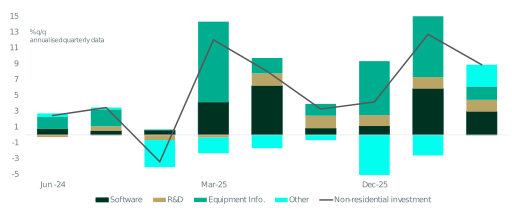
Investment in new technologies continues its boom and, in its wake, is driving exports from Asian countries producing chips and electronic equipment. Europe, where investment is still driven by defence and energy security, is gradually joining the race for new technologies. This theme should remain a growth engine in H2 26, with extensions into 2027.
The inflation peak has passed if the Strait of Hormuz reopens
Oil prices fell in June following the announcement of a memorandum of understanding between the US and Iran, but renewed strikes sent Brent crude back above USD 100/bbl in July. The prospect of reopening the Strait of Hormuz with no transit fees could push oil prices sustainably below USD 90/bbl. In such a scenario, the inflation peak would likely be behind us. In developed countries, inflation could stabilise and then gradually decline in the second half of the year. However, a return to a contained inflation regime between 2.0% and 2.5% is unlikely before spring 2027.
Alongside oil volatility, there are risks of sticky services inflation in the second half of the year, as demand remains resilient. However, stabilising oil prices would reduce the risk of spillovers of pressures to other sectors and wages. To validate this scenario, any new agreement between the US and Iran must prove more robust than June’s and enable a sustained normalisation of traffic through the Strait.
Patient but vigilant central banks
The European Central Bank (ECB) and several emerging market central banks have already raised policy rates in response to the pick-up in inflation. Overall, central banks have been patient, however, with growth and employment still solid, tolerance for price slippage may be limited.
With a peace agreement in the Middle East and lower oil prices, it would be easier for central banks to justify not raising rates in September or October. Thuerefore, the Fed and the Bank of England (BoE) should hold their rates steady, while the ECB is likely to raise its rates by 25 bps in September to 2.50%, as inflation would likely remain between 2.5% and 3.0% in the second half of the year even with some easing in energy. A few additional hikes may still occur in Asia, and pressure will remain high on the Bank of Japan (BoJ) after the late-July US-Japan concerted foreign exchange (FX) intervention.
US investment
New technologies - contribution to non-residential investment
Past performance is not a guide to current or future results. Any forecast, projection or target, where provided, is indicative only and is not guaranteed in any way.
How to get the full version of the UBP House View:
- Private clients: Please contact your relationship manager
- Institutional clients: Please contact your institutional representative
- All users: Subscribe to our UBP House View newsletter (fill out the form below and check the box "UBP House View")
The financial instruments and investment strategies portrayed in this document are for informative purposes only. They may differ from those effectively held in an investor’ portfolio. Depending on the jurisdiction and investment profile, one or some of these instruments and strategies – including, where applicable, options – may not be permitted, available or suitable. The opinions expressed herein are correct as at 11 August 2026 and are subject to change without notice. Any forecast, projection or target, where provided, is indicative only and is not guaranteed in any way.