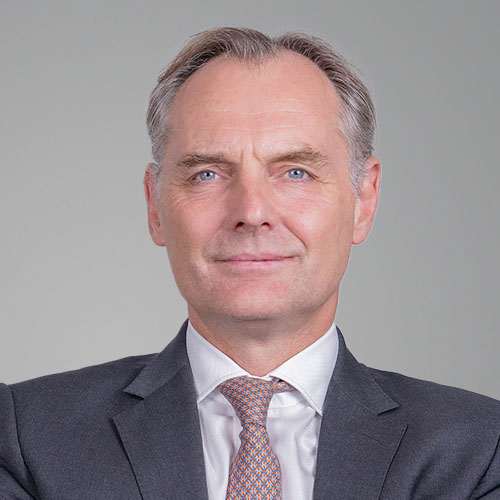
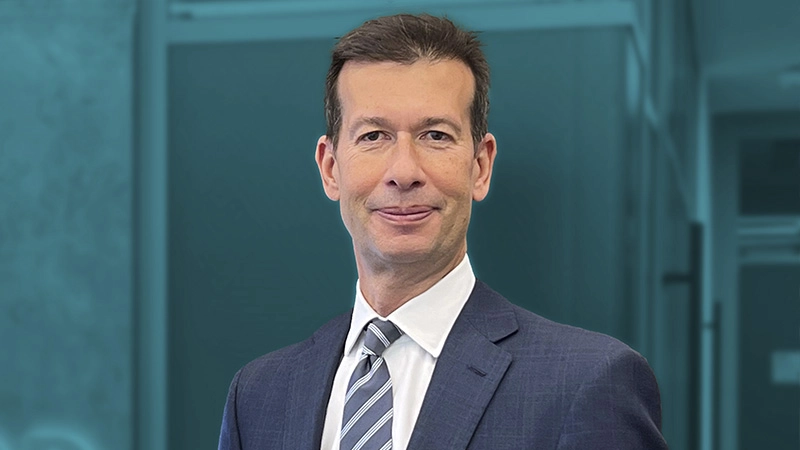
Nicolas Faller, Co-CEO of UBP Asset Management, which oversees EUR 34 billion in AUM, expresses confidence in a swift resolution to the conflict with Iran.
Nicolas Faller is Co-CEO of UBP Asset Management, the asset management arm of the private Swiss bank Union Bancaire Privée (UBP). Originally from a region located just a few kilometres from the Swiss–German border, Faller leads a division that manages around USD 40 billion (EUR 34 billion) within a group which has a total of around USD 200 billion in assets under management (AUM). The business has historically focused on private banking and is increasingly oriented towards asset management for institutional clients and international distribution.
Has the latest Middle East conflict triggered significant outflows from your asset management division?
No. January and February were very strong, and March was only slightly negative, with outflows of around USD 30 million – a marginal figure. We have not seen any panic or massive redemptions and many clients are opting for a wait-and-see approach, remaining in cash until there is more visibility in the market. April, so far, has been positive.
How do you think the situation with this conflict will evolve?
Ultimately, the market is more powerful than any political leader, including Trump. Every time he has made a very negative decision, as happened with the tariff announcement, the market has forced him to backtrack. On that occasion, he had to announce a partial 90-day truce in the trade war. Similarly, he has now been forced to agree to a ceasefire with Iran. Trump is a negotiator and knows that the economy is the key factor for his voters.
“Every time Trump has made a very negative decision, as with the tariffs, the market has forced him to reverse course.”
The rise in oil prices has been key.
Trump was elected under the slogan “America First”, but it seems he has already forgotten it. He has started a conflict and even he does not seem to know why. Discontent among his voters is gradually increasing. When they see the cost of filling their car’s tank rising, their frustration grows. Joe Biden paid the price for the high inflation of 2022, and Trump does not want to repeat that mistake, so he needs to stop the conflict now. The markets know this, which is why they have shown such resilience.
Are you concerned about a possible bubble in artificial intelligence?
I wouldn’t say there is a generalised bubble, but there are subsectors that are expensive relative to what they can deliver. At the same time, there are more mature areas of technology with potential and there are major divergences. Moreover, we do not believe that issues such as the energy transition or biodiversity have lost relevance; technology will be key to addressing these challenges.
“I wouldn’t say there is a generalised bubble, but there are subsectors that are expensive relative to what they can deliver.”
In recent months there have been problems in some closed-end private credit funds. What is happening?
We have been cautious for months. Some products were excessively concentrated and poorly diversified. Those that have faced the most problems lent a lot of money to software companies, which are now struggling. In Europe we are relatively protected by regulation, but we see the greatest risk in the United States, where certain semi-liquid products were inappropriately sold to retail clients. At UBP, we have decided to pause the promotion of perpetual funds to private clients and to analyse in detail the underlying assets, leverage, valuations, and liquidity.
How should investors understand this type of product?
A semi-liquid product should not be considered liquid. It should be treated as a very long-term illiquid investment: money that cannot be accessed for a long time – almost like an occupational pension plan. It only makes sense to use the exit windows they offer in exceptional circumstances.
Where do the flows received by UBP Asset Management mainly come from?
We work with both institutional clients – such as pension funds, insurers, and sovereign wealth funds – and with banks that include our funds on their open-architecture platforms. The business is roughly split 50/50 between institutional clients and third-party distributors. Of the USD 40 billion we manage, about USD 10 billion comes from internal private banking clients and around USD 30 billion from external clients.
What are the Bank’s key strategies today?
Our main focus is on active fixed income. We have extensive experience in high-quality credit, higher-yielding bonds, and emerging market debt, both corporate and sovereign.
In addition, we have developed multi-credit products that combine different sources of return and are now one of our main investment pillars. The second major pillar is hedge funds, an area in which UBP has historically been a significant player, both in funds of funds and single-manager strategies, supported by our proprietary selection and risk management platform. We also manage equities.
Is there interest in hedge funds in Spain?
It is gradually increasing. Between 2010 and 2020, with markets driven by central bank liquidity, hedge funds had a very difficult time. Since 2021, with higher volatility and rising interest rates, they have once again demonstrated their usefulness. We believe an allocation of around 10% may be appropriate for many clients.
And where is the focus in equities?
We mainly manage global and Swiss equities. In global equities, we have two approaches: a highly concentrated strategy with around 30 companies, and a less concentrated one with about 80 holdings. We also develop impact strategies, including one focused on biodiversity and another on emerging markets.
Last year was difficult for funds focused on quality companies. Why was that?
Managers who focus on the quality factor invest in companies that have demonstrated the ability to generate recurring earnings across multiple cycles. In recent years, however, the market has been dominated by technology stocks linked to artificial intelligence and semiconductors that had not yet proven such consistency. Since these stocks accounted for a large part of the global equity market’s gains, those who did not hold them underperformed the index.
Do you think a major rotation could occur in the market, from tech stocks to more traditional sectors?
It is difficult to say. For now, the market remains highly concentrated and volatile. That is why we believe that, at the moment, it makes sense not to deviate too far from the major indices and to maintain fairly well-diversified portfolios.
Marketing communication. For Professional Investors in Switzerland or Professional Investors as defined by the relevant laws. Past performance is not a guide for current or futures results.
The views and opinions expressed by fund managers (internal or external) may differ from the house view. They are shared for informational purposes and do not constitute investment advice or a recommendation.

.webp)