China’s fifteenth five-year plan (2026–2030), to be unveiled by the National People’s Congress in March, is expected to reshape how the People’s Bank of China manages the renminbi (RMB) exchange rate.
China’s fifteenth five-year plan (2026–2030), to be unveiled by the National People’s Congress in March, is expected to reshape how the People’s Bank of China manages the renminbi (RMB) exchange rate. Over the long term, Beijing appears set to prioritise current account liberalisation over a managed appreciation. The goal is to boost global demand for the currency, helping absorb external shocks while giving China’s emerging tech champions – the next generation of global innovators – a stronger platform to compete on the world stage.
Key takeaways
- The draft of China’s fifteenth five-year plan (2026–2030) will be released by the National People’s Congress in March and is anticipated to include reforms to how the People’s Bank of China (PBOC) manages the renminbi (RMB) exchange rate.
- Indicators such as purchasing power parity (PPP) and the real effective exchange rate (REER) suggest the RMB may face appreciatory pressures in 2026, supported by an ongoing weaker USD and potential interest rate cuts by the Federal Reserve.
- In the long term, China is likely to prioritise current account liberalisation over a managed appreciation of the renminbi in order to advance the currency’s internationalisation. This is a current account reform story.
- The objective is to increase global demand for the RMB, which should also play a role in absorbing external shocks and provide benefits for China’s companies, especially the new generation of global technology leaders.
- However, a successful RMB internationalisation will depend on structural reforms to address domestic challenges, such as issues in the real estate sector and state-owned enterprise (SOE) debt, to avoid economic instability.
A brief history of forex convertibility in China
Since the establishment of the People's Republic of China in 1949, the Chinese renminbi has remained largely non-convertible for both current account (trade-related) and capital-account (investment-related) transactions. Over time, however, its convertibility has evolved significantly, driven by China's deeper integration into the global economy. While this has led to greater liberalisation, particularly in trade-related transactions, the current account remains only partially open. Personal remittances, such as money sent by individuals to family members abroad, remain subject to restrictions. Meanwhile, the capital account remains largely closed, with strict restrictions on cross-border investments, such as purchasing foreign property or securities, and limits on the outflow of funds by individuals and companies. These restrictions continue to hinder full capital movement and foreign exchange (FX) convertibility, though reforms are expected to drive gradual change in the future.
As China transitions into a new growth paradigm under the fifteenth five-year plan (2026–2030), repositioning the RMB will be essential in addressing structural imbalances, supporting domestic economic rebalancing, and enhancing the global competitiveness of Chinese firms. Before exploring the specifics of these reforms, let us first take a step back to examine the historical evolution of the RMB’s internationalisation.
After 1949, the RMB was subject to strict government controls. China operated a socialist, centrally planned economy, with the state overseeing all aspects of production, trade, and foreign exchange. The RMB's value was set by the government and pegged to the USD at a fixed rate, with no market mechanisms to influence or adjust it. China's economy remained largely closed to the outside world during this period, with limited foreign trade and investment. This economic isolation minimised the need for a flexible exchange rate, as there was little engagement with international markets.
The ‘reform and opening up’ policy introduced in 1978 marked a pivotal moment in China's foreign exchange management system. The country moved from a strictly centralised framework to a dual exchange rate system, reflecting its shift from a planned economy to one that incorporated elements of market mechanisms. Around this time, Chen Yun, one of the most influential policymakers in China after Mao Zedong's death, introduced the concept of the ‘birdcage economy’. This approach allowed for the coexistence of market reforms while ensuring the state retained significant control over the economy. During this period, an official exchange rate was established, primarily serving state-owned enterprises (SOEs) and government transactions. However, this rate often diverged significantly from the weaker, market-driven offshore rate used by foreign companies, creating substantial arbitrage risks.
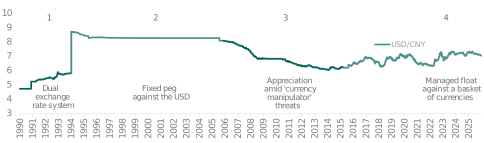
In 1994, China unified the official exchange rate with the market-determined rate in the foreign exchange swap market. Consequently, the RMB depreciated sharply against the USD, with the official exchange rate escalating from USD/CNY 5.2 to USD/CNY 8.7, converging with the weaker market-driven offshore rates. Pegging the RMB to the USD at this weaker level served a crucial purpose, enhancing stability, attracting foreign direct investment (FDI), and boosting exports. During this period, China also joined the World Trade Organization (WTO). China’s foreign exchange reserves experienced a fortyfold increase, rising from USD 21.2 billion at the end of 1993 to over USD 800 billion by the end of 2005. The official exchange rate remained remarkably stable, staying above USD/CNY 8.26 until mid-2005.
During the 2000s and early 2010s, China experienced a period of rapid economic growth, often referred to as its ‘boom years’. However, this remarkable expansion brought with it significant challenges, including economic overheating, a housing bubble, and overcapacity in certain industries. In response to these pressures, on 21 July 2005, the People’s Bank of China implemented a major policy shift by abandoning its fixed peg to the US dollar in favour of a managed floating exchange rate system.
This new system was designed to allow the RMB to gradually appreciate, preventing it from being locked at a fixed level and to help address some of the economic imbalances. As part of this framework, the PBOC began announcing a daily reference rate, known as the central parity rate, which served as a benchmark for the currency's value. The RMB was then permitted to fluctuate within a narrow band of ±0.3% around this rate. Although the exact composition of the currency basket used to determine the central parity rate was never disclosed, economists widely believed it was heavily weighted towards the USD.
Following the adoption of the managed float, the RMB appreciated from USD/CNY 8.30 in 2005 to USD/CNY 6.22 in 2015, marking a decade of gradual currency strengthening. Political considerations likely influenced this policy shift as well, as the US government had been pressuring China to allow its currency to appreciate, even threatening to label the country a ‘currency manipulator’ during the period.
Since then, China has progressively implemented reforms to move towards market-based mechanisms for determining the value of the RMB. In late 2015, the PBOC introduced the China Foreign Exchange Trade System (CFETS) RMB Exchange Rate Index, a significant tool for shaping the daily central parity rate. While the approach remained fundamentally a managed float, similar to the early 2000s, the introduction of the CFETS Index brought greater transparency and allowed market forces to play a more prominent role in influencing the RMB's value. Although the PBOC retained overall control, it began using a weighted average of quotes from major Chinese banks as the benchmark for daily trading. The composition of the basket of currencies used in determining this rate was also published for the first time. Additionally, the daily trading band was gradually widened from ±0.3% to ±2.0% around the central parity rate, providing more flexibility in the currency's movement. Contrary to the previous decade, the RMB entered a phase of gradual depreciation, with the RMB weakening from USD/CNY 6.22 in 2015 to USD/CNY 7.10 by 2025. This evolution is an ongoing process.
History of FX convertibility in China
| Dates | Regime | Policy Objectives | |
|---|---|---|---|
| 1 | 1978–1994 | Dual exchange rate system. |
|
| 2 | 1995–2005 | Pegged to the USD. |
|
| 3 | 2006–2015 | Managed float; reference basket unknown. |
|
| 4 | 2016–2025 | Managed float; reference basket with weights. |
|
| 5 | 2026–2035 | A new phase should be announced after March 2026. |
|
Sources: HKEX, PBOC, UBP
Exchange rate performance across different phases
Sources: Bloomberg Professional L.P., UBP
Read the full analysis for more insights.

The opinions expressed herein are correct as at 7 January 2026 and are subject to change without notice. Any forecast, projection or target, where provided, is indicative only and is not guaranteed in any way.