In a world shaped by higher interest rates, persistent inflation, geopolitical uncertainty and greater market dispersion, investors are rethinking the role of traditional portfolios.
For decades, the classic 60/40 model provided a straightforward framework for diversification. However, when equities and bonds decline together, as they did during the 2022 market sell-off, the limitations of relying primarily on these two asset classes become clear and this is where hedge funds and alternative strategies can play an important role: by accessing different sources of return, investment styles and risk premia, they can help investors build more resilient portfolios.
At UBP, we have been investing in alternatives since 1972. This long-standing commitment, combined with a dedicated global team and a rigorous manager-selection process, has made UBP one of the pioneers and most experienced players in hedge funds and alternative investments.
Hedge funds are not a single investment strategy: they encompass a broad range of approaches, including equity long/short, macro, systematic, relative value, event-driven and credit strategies. Each strategy behaves differently across market environments; some may benefit from rising rates, others from volatility or widening spreads; some seek to capture trends, while others aim to exploit relative mispricings between securities. Understanding these differences requires more than analysing recent performances: it requires experience across multiple market cycles.
The hedge fund industry has experienced very different periods over the past three decades. 1990–2009 was characterised by attractive opportunities to generate alpha from both long and short positions. The following decade proved considerably more challenging, as quantitative easing, low interest rates and compressed volatility reduced the opportunity set for many active managers. Since 2020, the return of inflation, positive real interest rates and greater dispersion across markets has created a more favourable environment for alternative strategies. At UBP, this cycle-aware perspective is central to our approach. We do not view hedge funds as a tactical trade or a short-term performance chase, rather, we believe they should be assessed according to the role they are expected to play in a broader portfolio, and over an appropriate investment horizon.
A global opportunity set, filtered by conviction
The challenge for investors is not simply about finding funds; it is about identifying managers with a repeatable investment process, robust risk management and the ability to generate genuine alpha. UBP’s alternatives team comprises 26 dedicated professionals. From a universe of approximately 8,000 to 10,000 funds, the team conducts a detailed analysis before narrowing down the opportunity set to around 100 funds to recommend to clients. This process combines quantitative screening with qualitative and operational due diligence. Track record, team experience, assets under management and investment breadth provide an initial framework, but these metrics are only the starting point, as a thorough assessment also considers:
- The quality and stability of the investment team
- The consistency of the investment philosophy
- The sources of historical returns
- Portfolio construction and liquidity
- Risk controls and leverage
- Operational infrastructure
- Capacity and scalability
- Alignment of interests
This depth of analysis is essential because past performance alone does not explain whether or not a manager can continue to add value. A strong track record may reflect skill, market beta, favourable conditions, or a combination of all three. Our objective is to understand what is driving returns and whether those drivers are likely to remain relevant in the future.
Innovation through partnerships and access
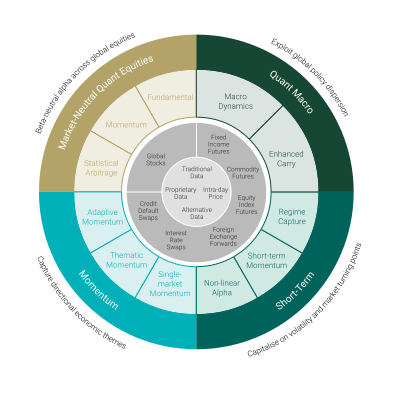
UBP’s alternatives platform combines multi-manager products and mandates with single-manager solutions available through its Alternative UCITS platform and thematic partnerships. This structure enables investors to access a broad range of strategies while benefiting from UBP’s research, selection and portfolio-construction expertise. One example is the partnership with Campbell & Co, a pioneer in systematic investing founded in 1972. Its systematic multi-strategy approach combines different investment styles, holding periods and instruments across fixed income, equity indices, foreign exchange, credit and cash equities. The strategy draws on more than 140 alpha sources across over 80 futures, forwards and swap markets, and more than 1,500 stocks. The value of such partnerships lies not only in access; it also lies in identifying managers whose capabilities are complementary, whose strategies are transparent, and whose risk characteristics can be understood within a diversified portfolio.
Building portfolios, not collections of funds
Selecting individual managers is only one part of the process; another challenge is combining them effectively. A portfolio can contain several funds and still be exposed to the same underlying risk factors. For example, a portfolio that appears diversified by number of managers may remain heavily exposed to equity beta, duration, credit spreads or liquidity risk. This is why UBP analyses hedge funds within the context of the entire client portfolio with the aim of identifying the risks already present and then selecting strategies that introduce a genuine range of sources of return. This may include:
- Equity alternatives, which seek to generate alpha from both long and short positions.
- Credit and relative-value strategies, which aim to capture pricing differences and opportunities created by dispersion.
- Macro and systematic strategies, which can benefit from trends, changing monetary policies and shifts in currencies, rates and commodities.
- Diversifying strategies, designed to reduce reliance on traditional equity and bond risk.
This portfolio-based approach is increasingly relevant because the historical negative correlation between equities and bonds turned positive from the end of 2021 and has remained positive since. In such an environment, alternative strategies can provide additional sources of return and help reduce concentration in traditional market risks.
The UBP difference
UBP’s position in hedge funds has been built over more than five decades, not through a single product or market cycle but through sustained investment in people, research, partnerships, infrastructure, and risk management. As markets become ever more complex, investors need more than access to alternative strategies; they need a partner capable of understanding how those strategies work, when they may add value and how they fit within the wider portfolio. At UBP, we believe that is the role of a global alternatives’ specialist: to transform a complex universe of hedge funds into thoughtful, transparent and purposeful investment solutions.
For Professional Investors in Switzerland or Professional Investors as defined by the relevant laws. Investments in hedge funds involve significant risks, including the risk of illiquidity, of loss of capital, strategy‑specific and leverage related-risks.
The opinions expressed herein are correct as at 23 October 2026 and are subject to change without notice. This information should not be relied upon by the reader as research or investment advice regarding any particular fund, strategy or security. Past performance is not a guide to current or future results. Any forecast, projection or target, where provided, is indicative only and is not guaranteed in any way.
The views and opinions expressed by fund managers (internal or external) may differ from the house view. They are shared for informational purposes and do not constitute investment advice or a recommendation.