When traditional assets increasingly share the same global drivers, diversification may depend on finding genuinely different sources of return.
Diversification is a fundamental principle of portfolio construction, but owning more securities does not necessarily mean owning more independent sources of return.
Recent market moves provide a striking example: energy prices have become an unusually powerful driver of developed-market bonds. In September, the three-month correlation between WTI oil prices and the US 10-year Treasury yield reached 65% – its highest level since 19901. The relationship has also been visible across European government bond markets, as higher energy prices have fed inflation concerns and changing expectations for monetary policy.
For investors, this presents a challenge. A portfolio can contain many different securities, but if they are increasingly responding to the same global forces, the diversification they provide may be less effective precisely when it is needed most.
This is where emerging market debt can add another dimension.
EMD is not fully insulated from global shocks, but it provides exposure to economies with different monetary cycles, currencies and domestic drivers, and, importantly, many of these markets have become more resilient to the external shocks that historically dominated their performance.
1Financial Times, 29 September 2026.
When different assets share the same risks
Historical relationships help illustrate the challenge. How closely have different assets moved together?
|
Performance |
Global bonds |
US equities |
|---|---|---|
|
US investment grade |
0.85 |
0.34 |
|
US high yield |
0.62 |
0.72 |
|
EM corporate |
0.67 |
0.40 |
|
EM sovereign |
0.72 |
0.53 |
|
EM local currency |
0.68 |
0.47 |
|
Frontier market |
0.50 |
0.54 |
Sources: Bloomberg Finance L.P., UBP calculations. Weekly performance data from 30 September 2020 to 30 September 2026. Global bonds: Bloomberg Global Aggregate Index; US equities: S&P 500 Index; US investment grade: ICE BofA US Investment Grade Index; US high yield: ICE BofA US High Yield Index; EM corporate debt: J.P. Morgan CEMBI Broad Diversified; EM sovereign debt: J.P. Morgan EMBI Global Diversified; EM local-currency debt: J.P. Morgan GBI-EM Global Diversified (Unhedged); frontier-market debt: J.P. Morgan NEXGEM. Past performance is not a guide to current or future results.
The closer the number is to 1, the more two investments have tended to move together. The results reveal an important distinction: US investment-grade bonds have historically moved closely to the broader global bond market, while US high-yield bonds shared more of the behaviour of equities.
EMD shows a different pattern, and, importantly, not the same one across every segment.
EM corporate debt has shown relatively low correlation with US equities, while frontier debt has been particularly differentiated from global bonds, sovereign and local-currency debt sit somewhere between the two.
This matters because the diversification case for EMD does not depend on finding one segment that behaves differently from everything else; it comes from combining markets whose return drivers are themselves different.
That breadth gives investors access to something increasingly valuable: more than one way to diversify.
Emerging markets are not what they used to be
In previous cycles, higher US rates, a stronger dollar or an external inflation shock could quickly expose vulnerabilities across emerging markets. Today, the starting point is different.
Many EM central banks responded to the 2022 inflation shock earlier than their developed market counterparts. This policy discipline helped preserve debt ratios, current accounts, fiscal balances, real interest rates and foreign-exchange reserves.
The investor base has changed too. Domestic investors now hold close to 87% of EM local debt2. Deeper local pension, insurance and savings pools provide a more stable source of demand and reduce the dependence on foreign capital that amplified previous periods of market stress.
This is an important structural shift.
Global shocks still reach emerging markets, but, increasingly, what happens next is determined locally.
Inflation can be different. Monetary policy can be different. Fiscal conditions can be different. And the response of bonds and currencies can therefore also be different.
As Thomas Christiansen, UBP’s Head of Emerging Markets Fixed Income, has highlighted, ‘improving policy frameworks and deeper domestic markets mean that many EM economies are increasingly driven by their own economic cycles rather than simply following the Federal Reserve.’
Thomas Christiansen, Head of Emerging Markets Fixed IncomeImproving policy frameworks and deeper domestic markets mean that many EM economies are increasingly driven by their own economic cycles rather than simply following the Federal Reserve.
Recent decisions illustrate this independence. While the Fed has raised rates and may consider further tightening, Brazil has been cutting rates, South Africa has been hiking its rates and Hungary has been holding steady. Nigeria and Zambia have delivered much larger cuts, while Colombia has also followed its own path, driven primarily by domestic inflation and growth conditions.
There is no single EM monetary cycle – central banks are increasingly responding to their own domestic conditions rather than simply following the Fed.
The shock may be global; the investment outcome for emerging markets does not have to be.
2J.P. Morgan Market Research, Global Bond Monitor Q3 2026 and ‘EM local heroes’.
When diversification improves the portfolio
Different return drivers are valuable, but ultimately diversification has to work at portfolio level.
UBP tested this through an efficient-frontier analysis over five years. Starting with a traditional portfolio of global bonds and equities, adding each of the EMD segments analysed improved the historical risk-return profile, increasing potential returns without a proportional increase in risk.
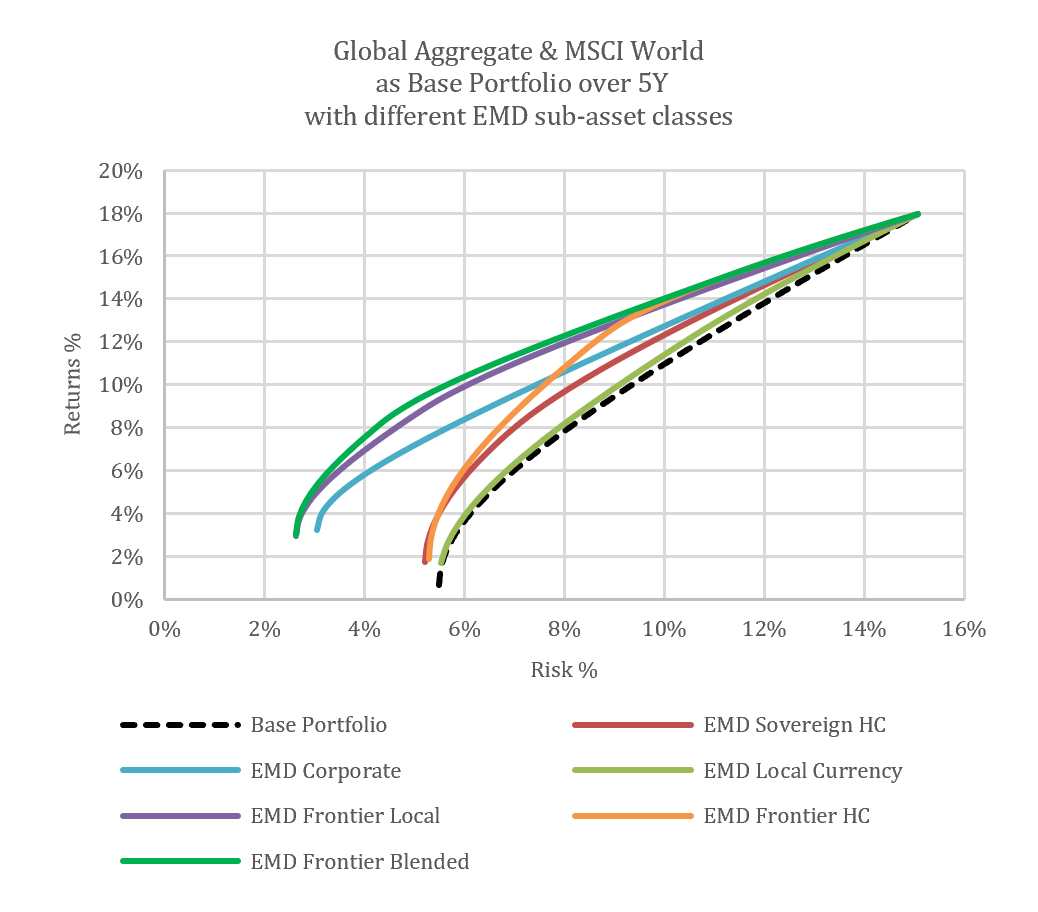
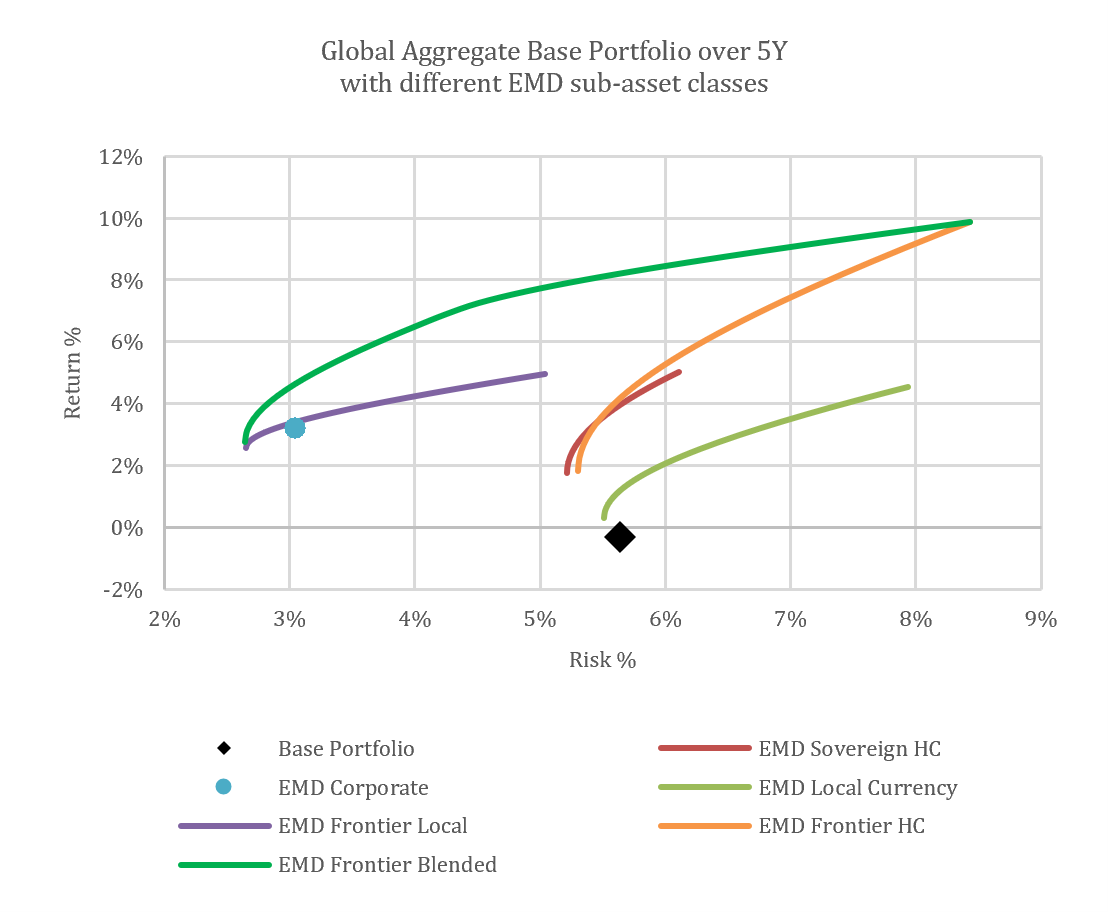
*Sources: Bloomberg Finance L.P. and UBP calculations. For illustrative purposes only. Data from 31 August 2021 to 31 August 2026. Balanced base portfolio: Bloomberg Global Aggregate Index and MSCI World Index; fixed-income base portfolio: Bloomberg Global Aggregate Index. EMD Corporate: J.P. Morgan CEMBI Broad Diversified; EMD Sovereign HC: J.P. Morgan EMBI Global Diversified; EMD Local Currency: J.P. Morgan GBI-EM Global Diversified; EMD Frontier Local: Frontier Market Composite Index (Local Currency); EMD Frontier HC: J.P. Morgan Next Generation Markets Index (NEXGEM); EMD Frontier Blended: 50% Frontier HC / 50% Frontier Local. Past performance is not a guide to current or future results.
The results were particularly notable for frontier blended currency debt, hard-currency sovereigns and EM corporates. Furthermore, the effect was not limited to multi-asset portfolios: within a pure fixed-income allocation, EM corporate and frontier debt also historically improved return potential relative to traditional developed market bonds while maintaining attractive risk characteristics.
A stronger role in global portfolios
The evidence points to a broader role for EMD in global portfolios. Attractive income does not have to come at the expense ofdiversification. Across a wide and increasingly mature investment universe, investors can access both, while gaining exposure to opportunities that traditional developed market allocations may not capture.
For investors, that makes EMD particularly relevant today. The objective is not simply to add more yield or more assets, but to build a portfolio with more ways to perform.
At Union Bancaire Privée, our emerging market debt platform brings together more than 20 years of experience investing across the asset class, with dedicated expertise spanning hard-currency sovereigns, corporate credit, local-currency debt and frontier markets. This breadth allows our specialists to assess opportunities across the full EMD universe and identify where different sources of income and return can contribute most effectively to global portfolios.
The opinions expressed herein are correct as at 6 October 2026 and are subject to change without notice. This information should not be relied upon by the reader as research or investment advice regarding any particular fund, strategy or security. Past performance is not a guide to current or future results. Any forecast, projection or target, where provided, is indicative only and is not guaranteed in any way.
The views and opinions expressed by fund managers (internal or external) may differ from the house view. They are shared for informational purposes and do not constitute investment advice or a recommendation.