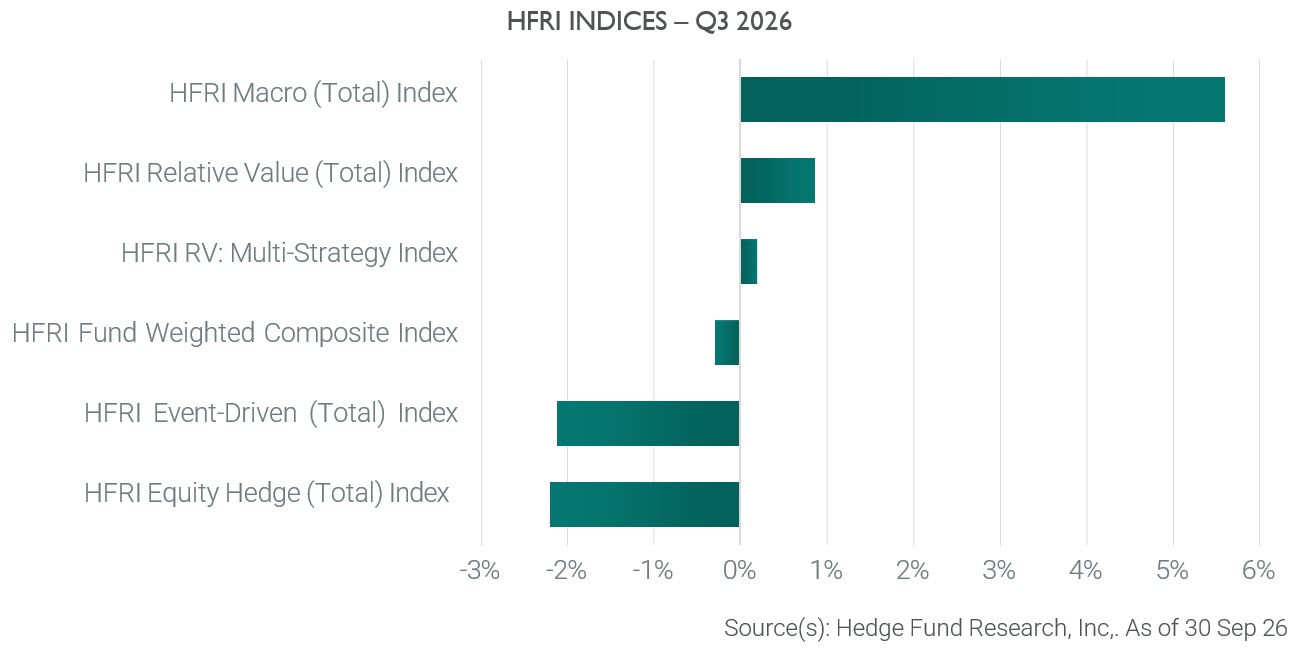
Following an exceptionally strong second quarter for hedge funds, the Q3 saw a period of consolidation, with a sharp rotation in the relative performance of hedge fund strategies.
Key points
- After an exceptionally strong second quarter for hedge fund performance, the third quarter was a period of consolidation as there was a sharp rotation in relative performance of hedge fund strategies. There are two interconnected themes which are having a profound impact on various traditional asset classes and the related hedge fund strategies – artificial intelligence (AI) capex spend is having a sustained impact on real economic growth and earnings, and the decline in global savings is causing bond yields to rise.
- Within equity strategies, July’s technology sector selloff appears to have been a technical correction as leverage was aggressively reduced. Looking forward, underlying earnings growth and valuations remain attractive, but in old economy sectors – including Europe – a higher cost of capital could suppress valuations further.
- In the credit space, we continue to have a constructive view on Convertible Bond Arbitrage based on both the quality of the managers and the underlying market fundamentals. Fixed Income Relative Value (RV) remains challenged due to market structure.
- Demand for hedge fund exposure continues to accelerate as investors return to the asset class. The challenge is that high profile managers have closed to new capacity, thus replicating historic performances for new investors will be difficult.
Performance review
Strategy performance
After the risk on equity rally of Q2 26, July was initially marked by a sharp correction, in some cases greater than −50%, in overheated AI-related stocks. This appeared to reach a floor as more aggressively positioned funds were forced to reduce leverage, allowing liquidity providers the opportunity to capture the relief rally. Whilst technology-related equity markets remain driven by strong earnings growth and positive cash flow, old economy and fixed income markets were negatively impacted by the higher interest rates across developed markets. The US Federal Reserve’s (Fed) pivot to a more hawkish stance and US Treasury attempts to flatten the yield curve highlighted the tightening of liquidity conditions for investors. This led to weakness in rates-sensitive equity sectors such as real estate and utilities, whilst fixed income yields increased through a combination of higher rates and wider credit spreads. This proved a more challenging environment for Equity Long Short (L/S) and RV strategies. In contrast, Macro strategies were largely short fixed income.
Sub strategy performance
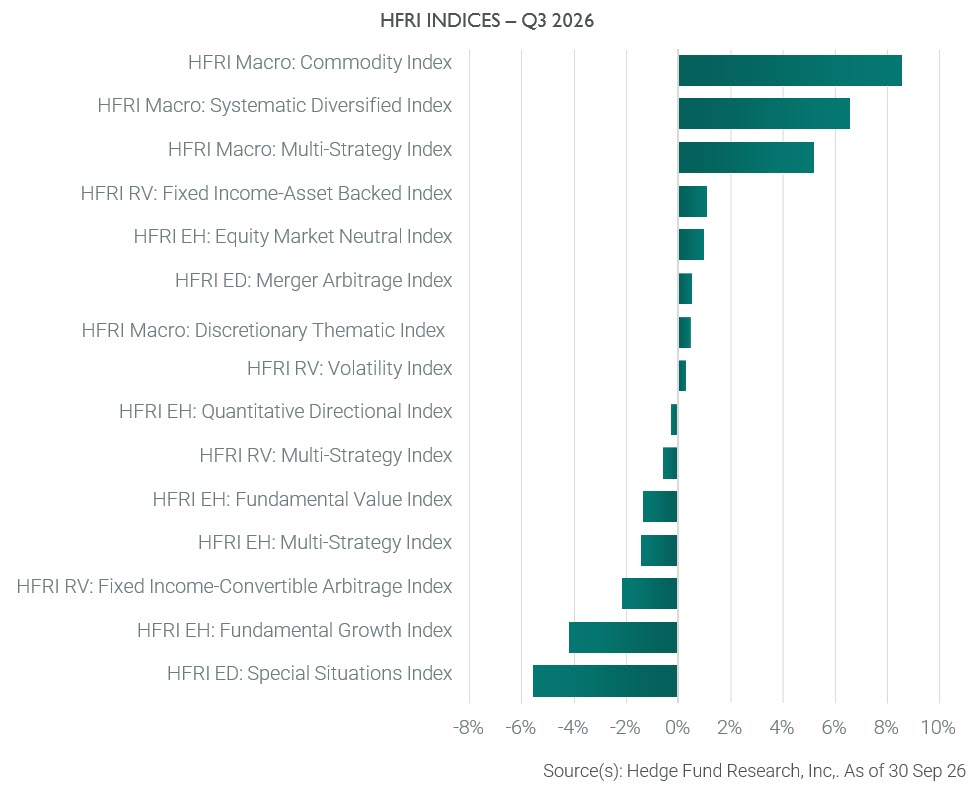
Systematic Macro strategies generated a standout quarter of performance driven by market technicals/momentum within developed market government bond markets. Short positioning in the long end of yield curves captured the sell-off in France and the US as 10-year yields passed 5.2%. Gains were generated across most holding periods and led to some of the best single month gains in September for underlying managers. In contrast, fundamental driven strategies struggled as Discretionary Macro managers held dovish views on inflation expressed via long bonds, only for the Fed to shift its stance and hike rates by 25 basis points (bps). Fundamental Growth managers which had been crowded into a small number of AI “hot stocks” were forced to de-risk through July and so missed the subsequent rebound. Finally, Fixed Income RV managers struggled as more macro related spreads widened across different markets.
Hedge Fund Insights
Why are there so few long-levered hedge funds?
It is a simple question: why are there not more hedge funds that apply leverage to a concentrated portfolio of high-quality assets? Given that markets have been in a largely risk-on bull market since 2009, why not buy 10 to 20 great assets and run them hot with leverage?
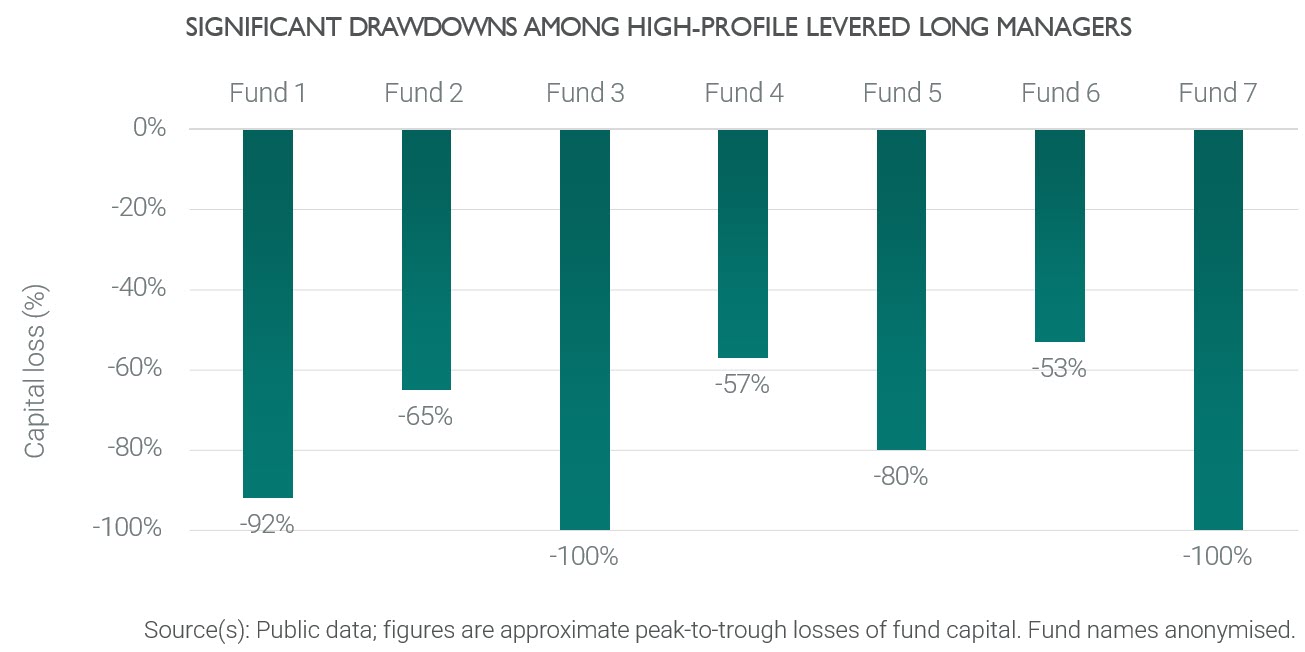
The superficial answer is that many have tried, and they tend to fail spectacularly rather than exit with a whimper. The headlines around Situational Awareness and some of its peers during July’s AI-related equity sell-off sound sensational: the fund had grown to USD45bn at its peak and posted stunning returns, before losing roughly two-thirds of its value in less than a month.
But these headlines are not new; they are part of a repeating pattern. Archegos Capital Management collapsed in 2021, with wider implications for Credit Suisse, and a number of European equity funds met a similar fate in 2008. Nor is the pattern limited to equity managers. Credit investors, who are meant to be more conservative, followed the same blueprint of failure in asset-backed securities (ABS) and mortgage-backed securities (MBS), led by the Bear Stearns funds at the onset of the 2007‒08 Global Financial Crisis (GFC). And LTCM in 1998 showed that a fund’s approach can have impacts well beyond losses for its investors.
Hedge fund failures: peak capital loss
Is there a common thread in why they fail?
One reason is that investors suffer from acute recency bias, which seems to be increasing as investors become ever more short-term focused, and find it difficult to remember the lessons of previous bear markets. This is why both managers and investor appear to fail to learn and go onto repeat the same mistakes and we see a major fund blow-up occurring every five or so years.
Another reason is fund’s operational set-up. As with any leveraged investing, it is the security and permanence of your funding and asset base which allows you to weather fluctuations in value. Prior to 2014, hedge funds still tended to offer quarterly or more frequent redemption liquidity. This meant that in stressed markets when investors needed liquidity through fund redemptions, levered funds became forced sellers at precisely the wrong time, crystallising losses and triggering further “runs” on the fund. This was prevalent during the GFC; as funds gated, this in turn triggered runs on other funds and on the prime brokers.
Since 2014, the hedge fund industry has addressed this issue by implementing investor-level gates, which avoids forced deleveraging and is becoming widely accepted. Strategies such as platform / multi portfolio manager have pushed redemption terms out even further to minimise this risk.
Of greater concern is the third reason; portfolio risk management – where overconfidence and over reliance on standard risk metrics supports higher levels of risk. If managers were more focused on stressed conditions when thinking about portfolio construction and recognised that equities have a large negative skew (fat left tails), then we might see a greater number of long (but less leveraged) funds remaining as a percentage of the hedge fund universe.
A better measure of potential loss in stressed conditions is not Value at Risk (VaR), but Conditional VaR (CVaR), which measures the average expected loss in the worst 5% of outcomes. For the MSCI World Index in USD, CVaR currently implies an expected loss of 14%. Apply around 3x leverage and the expected loss rises to over 40%; for more volatile markets such as the Nasdaq, the potential loss is far greater.
What is the solution for investors?
Philosophically, investors must understand that their hedge fund allocation is designed for resilient wealth creation, not to “get rich quick”. Where an investor has a strong conviction on a theme, it could be executed more efficiently and would be more liquid through a delta-one or options-based structure rather than through a hedge fund.
When selecting and monitoring managers, investors should:
- Invest with managers who have been managing money in their strategy through at least one crisis period.
- Ensure the fund’s liquidity terms match the liquidity profile of the underlying strategy and assets.
- Only invest in levered strategies that invest in liquid, well-functioning asset classes.
- Focus due diligence on the manager’s portfolio construction and risk management, including the risk function’s independence from the investment team.
For Professional Investors in Switzerland or Professional Investors as defined by the relevant laws. Investments in hedge funds involve significant risks, including the risk of illiquidity, of loss of capital, strategy‑specific and leverage related-risks.
The opinions expressed herein are correct as at 30 October 2026 and are subject to change without notice. This information should not be relied upon by the reader as research or investment advice regarding any particular fund, strategy or security. Past performance is not a guide to current or future results. Any forecast, projection or target, where provided, is indicative only and is not guaranteed in any way.
The views and opinions expressed by fund managers (internal or external) may differ from the house view. They are shared for informational purposes and do not constitute investment advice or a recommendation.