The Federal Reserve cut its key rates by 25 basis points to 3.25 - 3.75% last week, and surprised observers with the resumption of purchases of short-term Treasuries. The Fed also raised its 2026 growth forecasts to 2.3%. However, we maintain our current scenario of several Fed rate cuts in 2026.
On the equities markets, valuation concerns have resurfaced for AI-related companies, even as the Artificial Intelligence (AI) investment outlook remains robust, while risk appetite expends to cyclical equities. Such dynamics underscore the need for diversification and selectivity as we enter 2026.
Market recap

Beyond the numbers
Macroeconomics
As expected, the Fed cut its key rates by 25 basis points to 3.25–3.75%. However, the decision to renew purchases of short-term Treasuries to replenish bank reserves over the coming months came as a surprise.
The FOMC dot plot was unchanged and indicated only one rate cut in 2026 and one in 2027.
The Fed's growth forecasts were revised upwards for 2026 to 2.3%, with a further increase to 2.0% in 2028. Core PCE inflation was revised down slightly to 2.5% in 2026 and 2.1% in 2027.
We maintain our current scenario of several Fed rate cuts in 2026.
The economic indicators were mixed in terms of labour: the JOLTS survey was positive (7,670,000 in November), but the increase in job offers centred on the retail and healthcare sectors.
In the eurozone, German industrial production was higher than expected in October (1.8% m/m) and the final November CPI was higher for Germany (2.6% y/y) and Spain (3.2% y/y), while inflation in France remained below 1.0% (0.8% y/y). In Switzerland, the Swiss National Bank (SNB) left key rates unchanged at 0.0%, revising its inflation forecasts down to 0.3% for 2026 and 0.6% for 2027.
There are a lot of economic indicators and central bank meetings this week. In the US, employment figures for November are expected to be positive (50,000), but the unemployment ratio is expected to increase further to 4.5%. US inflation for the month is expected to remain above 3.0% y/y. Flash PMIs will be released, as will many other indicators in China and the UK.
The European Central Bank (ECB) is not expected to change key rates, while the Bank of England (BoE) is expected to ease its rates and the Bank of Japan (BoJ) may hike its key rates. Many central bank meetings will be held across Europe and in emerging market countries.
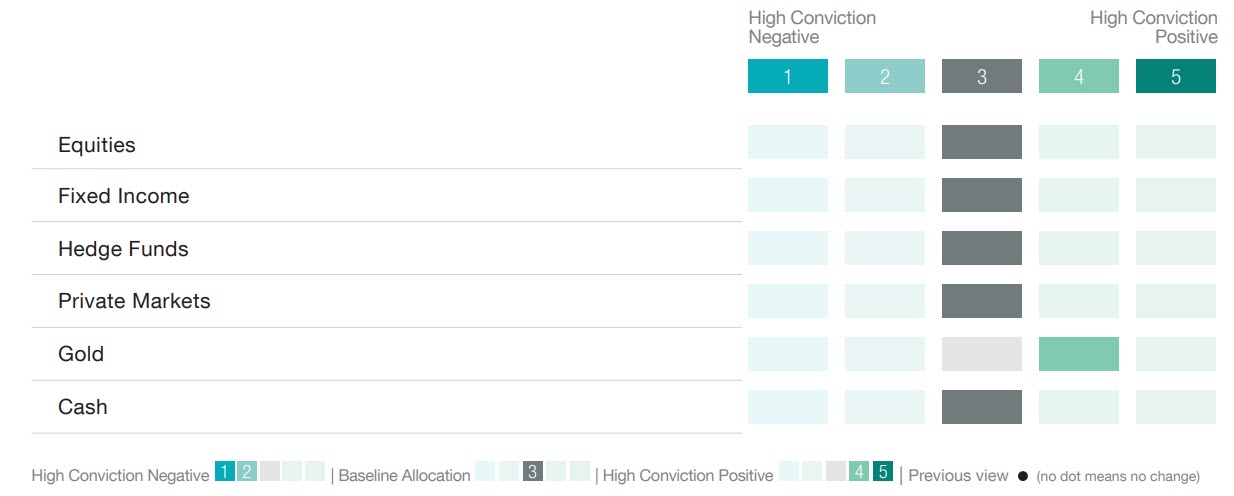
Asset allocation: strategic views as at December 2025
Equities
Global equities ended last week modestly lower (MSCI ACWI total return -0.2%), weighed down by losses in the technology (-1.8%) and communication services (-2.6%) sectors, which together account for 37% of the global market.
As partially observed last week, investors rotated in a more obvious manner into cyclicals, with the US Federal Reserve carrying out its third consecutive rate cut. Global financials (+2.0%), materials (+1.8%), and industrials (+1.4%) were the week’s biggest gainers, with risk appetite also supported by less-hawkish-than-feared comments from Fed Chair Powell.
Disappointing results and guidance from technology heavyweights Oracle and Broadcom also contributed to the rotation, as growth and valuation concerns resurfaced for AI-related companies, even though the AI investment outlook remains robust.
Against a backdrop of sustained economic growth, with inflation and tariffs potentially being less of a drag, fiscal incentives taking effect, and financial conditions easing, the theme of broadening earnings growth beyond the technology sector adds another driver to the asset class in 2026; this further supports our current positioning as we head into the new year.
Broadening earnings growth beyond technology adds another tailwind for the asset class in 2026
Fixed income
Fixed income’s performance for the week was muted. The Fed delivered a widely expected 25-bp cut, with 10-year Treasury notes ending the week marginally up at 4.18%. The spotlight remained on deepening divisions within the Fed: three dissents from the 25-bp cut (one for 50 bps, two for no cut) and an updated dot plot showing greater dispersion in individual dots for 2026. At his press conference, Chair Powell adopted a cautious, data-dependent stance, noting the policy rate is now near neutral and implied the ‘risk-management’ cuts are done. A final note of support came from the announcement of the purchase of around USD 40 billion in short-dated Treasury bills to bolster liquidity and maintain ample reserves. In this context, fixed income’s performance remained subdued.
In the eurozone, influential ECB voices – including Executive Board member Isabel Schnabel – have signalled that the next policy move could be a hike rather than a cut, as inflation stabilises around 2% with upside risks from resilient growth. That said, no near-term tightening is anticipated.
On the corporate side, Oracle's CDS spreads continued to widen, reaching around 148 bps by Friday amid a tech sector sell-off. The move was amplified by disappointing earnings and mounting concerns about massive AI-related capex needs.
Amid a 25-basis point Fed rate cut, fixed income’s performance remained subdued
Forex & Commodities
Last week, the US dollar weakened against the majority of G10 and emerging market currencies. The US Federal Reserve’s 25-bp rate cut was perceived as being on the slightly dovish side, and the EUR/USD broke above key levels to make gains towards highs of 1.1750. We note that several ECB speakers highlighted increasing upside growth risks, and overnight index swaps (OIS) moved to price in ECB deposit rate hikes in 2026 with a 20% probability. The implication from this is that front-end rate spreads are moving in favour of the euro, supporting further gains going into year-end. The main data releases will be the publication of retail sales (October) and inflation data (November). Any weakness in the data will be punished by the market, resulting in further modest USD weakness.
CHF exchange rates rose following the SNB’s meeting, at which it left rates on hold at 0.00%. The SNB’s conditional inflation forecast was reduced only marginally, and the SNB issued a constructive update on growth expectations. Two-year SARON swaps moved to price out a negative deposit rate profile, which benefitted the CHF. The coming week is relatively light in terms of domestic data, so the USD/CHF will be led by US data releases.
The USD/JPY traded at levels close to 155 over the week, and we note that BoJ Governor Ueda gave clear guidance that rate hikes may be forthcoming at this week’s BoJ meeting (19 December). The market is unlikely to buy JPY aggressively on a 25-bp deposit rate hike, given the already-rich front-end pricing. Overall, we struggle to anticipate aggressive JPY appreciation in the short term.
Last, both gold and silver traded towards higher levels of just below USD 4,300 and USD 64 per oz, respectively. Both metals benefitted from the Fed’s slightly dovish tilt. Silver’s rise in particular is notable, and the gold-silver ratio broke below important technical levels. We maintain a constructive stance on gold, anticipating that it will rise to levels of USD 4,600 per oz by Q4 2026.
Front-end rate spreads are moving in favour of the euro, supporting further gains as we move into year-end
The opinions expressed herein are correct as at 15 December 2025 and are subject to change without notice. This information should not be relied upon by the reader as research or investment advice regarding any particular fund, strategy or security. Past performance is not a guide to current or future results. Any forecast, projection or target, where provided, is indicative only and is not guaranteed in any way.