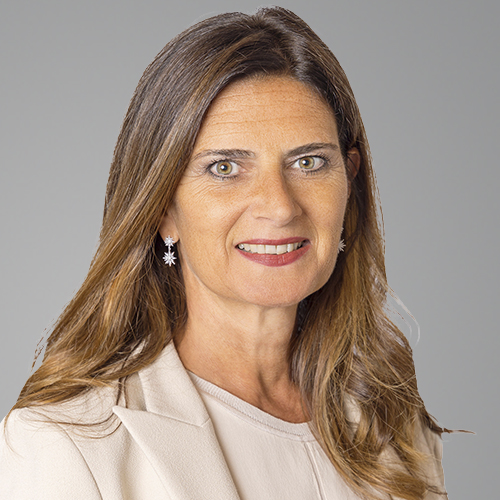
Head of Wealth Management Developing markets & Europe Nadège Lesueur-Pène lifts the lid on UBP’s business strategy and the unusual origins of her career.
How many private bankers read political science and Russian philology, including a year studying abroad in Moscow before the dissolution of the Soviet Union?
Not many. But that was Nadège Lesueur-Pène’s life before business school. Her favourite writers include Dostoyevsky, who she read in the original Russian, while Kafka’s The Castle stands out as a useful warning on the perils of bureaucracy.
After senior private and investment banking posts at BNP Paribas and HSBC, Lesueur-Pène joined UBP in 2015. Now head of Wealth Management Developing markets and Europe at UBP, she thinks the bank benefits from a flat structure, pragmatism and a certain dynamism linked to its founders, the de Picciotto family.
‘The CEO [Guy de Picciotto] has been running the bank for more than 30 years, and he is really deeply involved,’ Lesueur-Pène said.
UBP has nine booking centres worldwide, and Lesueur-Pène is keen to emphasise its global reach.
Her staff in Geneva cover Swiss and French clients, while she also supervises branches in Lugano, Lisbon and Monaco.
Her developing market remit includes the Middle East, where UBP has a branch in Dubai, Africa, Latin America and Eastern Europe. She also oversees bankers covering external asset managers.
UBP’s Swiss identity remains an attraction for many of its international clients.
‘We saw huge interest in Swiss booking for that reason because it’s quite unstable now in Eastern Europe, the Gulf, and for political reasons as well in all areas, and that’s really where Switzerland can make the difference.’
Switzerland will continue to grow, even if it won’t necessarily be at the same pace as, for example, Asia.
In fact, the Swiss-based clientele includes plenty of international origin.
The takeover of Societe Generale’s Swiss private banking unit has ‘reinforced our teams,’ Lesueur-Pène said.
Two-thirds of the clients it brought are Swiss-based.
These include external asset managers and ‘very nice clients of Swiss entrepreneurs and French entrepreneurs who relocated to Switzerland’.
The remaining third of the clients who are international are mainly Middle Eastern, but also include some European markets.
UBP also bought Societe Generale’s UK private banking business. While the UK operations do not report to Lesueur-Pène, she said: ‘It was really a game changer in the UK in terms of assets, in terms of domestic clients, in terms of clientele.’
Some redundancies were made in both the Swiss and UK units following the takeovers. How does UBP manage this process?
‘First we freeze the recruitments on UBP side, and then we give priority to, let’s say, the acquired employees, so we manage to limit the number of redundancies.’
In the Middle East, UBP has close to 50 people based on the ground. ‘That’s our main market,’ she said.
UBP has been focused on building up its presence in that region over the last three years to benefit from huge wealth creation and a lot of expats rotating through.
As well as an office in Dubai, UBP opened a branch in Saudi Arabia, which Lesueur-Pène described as a growing market, a year ago.
When it comes to the Middle East, she said: ‘The main issue there is recruiting talents because we are all competing for the same people, and people are really moving from one bank to the other.’
Unsurprisingly, considering her Russian language skills, Lesueur-Pène has a long background in covering Eastern European markets.
‘We have historical clients. Most of them exited Russia, even long before the war. We are extremely careful, because what really might worry banks is not only the direct sanctions, but the indirect sanctions, not only with the Russian clients but with the neighbouring countries.’
Whatever happens to Russia going forward, Lesueur-Pène has kept the lessons learned from the time spent there studying and a stint working there for BNP Paribas, when she witnessed the evolution away from a communist planned economy.
‘It’s an experience that is difficult to find anywhere else in the world.’
Centre the client
According to Lesueur-Pène, flexibility and agility are important values for UBP. She said the bank has internal service level agreements which set clear deadlines for responding to clients, particularly during the onboarding process.
‘At the executive committee, decisions can be made immediately… we tend not to have too many committees.’
While it did not provide a specific percentage, UBP told Citywire that at a group level, assets under discretionary mandates increased two and a half-fold between 2023 and 2026.
‘In some countries advisory is difficult to deliver, particularly with the upcoming CRD 6 rules in Europe. Once you have demonstrated your expertise and ability to deliver performance, clients begin to trust you and may give you a mandate.’
Lesueur-Pène said another element which separates UBP from some other banks is how close the asset management unit is to the private bank.
‘In very big banks, private banking and asset management are usually two separate divisions, with separate research teams and separate CIOs, whereas at UBP, these functions are much more closely integrated.’
UBP’s private bank delegates the management of mandates for key clients to the asset management team.
While Lesueur-Pène did not specify their exact level, UBP has limits on the percentage of internal products allowed in client portfolios.
One area where this bundled expertise can be helpful is hedge funds.
‘Even after 2008, we strongly believe in hedge funds, although their performance over the following 15 years was disappointing. So we are very happy to have kept our research teams because it’s really attracting huge interest, especially from family offices and from high net worth clients.’
In UBP’s financial report for the first half of this year, there was commission income on securities trading and investment transactions of CHF 479.9m, up 16.3% year on year.
‘Despite the turmoil in financial markets in March and the geopolitical context, clients remained highly active, which contributed to revenue generation. In addition, we are seeing an increasing share of recurring management fees as well.’
After net profits of CHF 169.4m in the first six months of 2026, what does the bank expect for the remainder of the year?
Lesueur-Pène said: ‘We had a strong first half, with profits up 40%, and remain optimistic about the second half of 2026. However, given the current environment, including interest rate volatility, inflation and the upcoming US midterm elections, we remain cautious about the outlook for the full year.’