Global power demand is entering a new and sustained growth phase, marking a clear shift from the flat or declining trends seen in developed markets over much of the past two decades. This change is being driven by the need to upgrade infrastructure and by rising power demand not seen for years in developed economies.
Growth in power demand is a consequence of electrification trends, energy security priorities, and the rapid expansion of data centres linked to artificial intelligence and cloud computing. Together, these forces are creating a long-term investment opportunity across the power and utilities value chain, ranging from raw materials suppliers and industrial and service companies to utilities.
Global electricity consumption is forecast to grow at its fastest pace in over twenty years, with demand expected to increase by around 3,000 terawatt hours over the next three years alone, equivalent to adding the annual electricity consumption of Japan. This acceleration comes at a time when much of the existing power infrastructure in developed economies is ageing and in need of significant upgrading after decades of underinvestment. At the same time, economies are becoming more electrified as transport, heating, and industrial processes increasingly shift away from fossil fuels towards electricity.
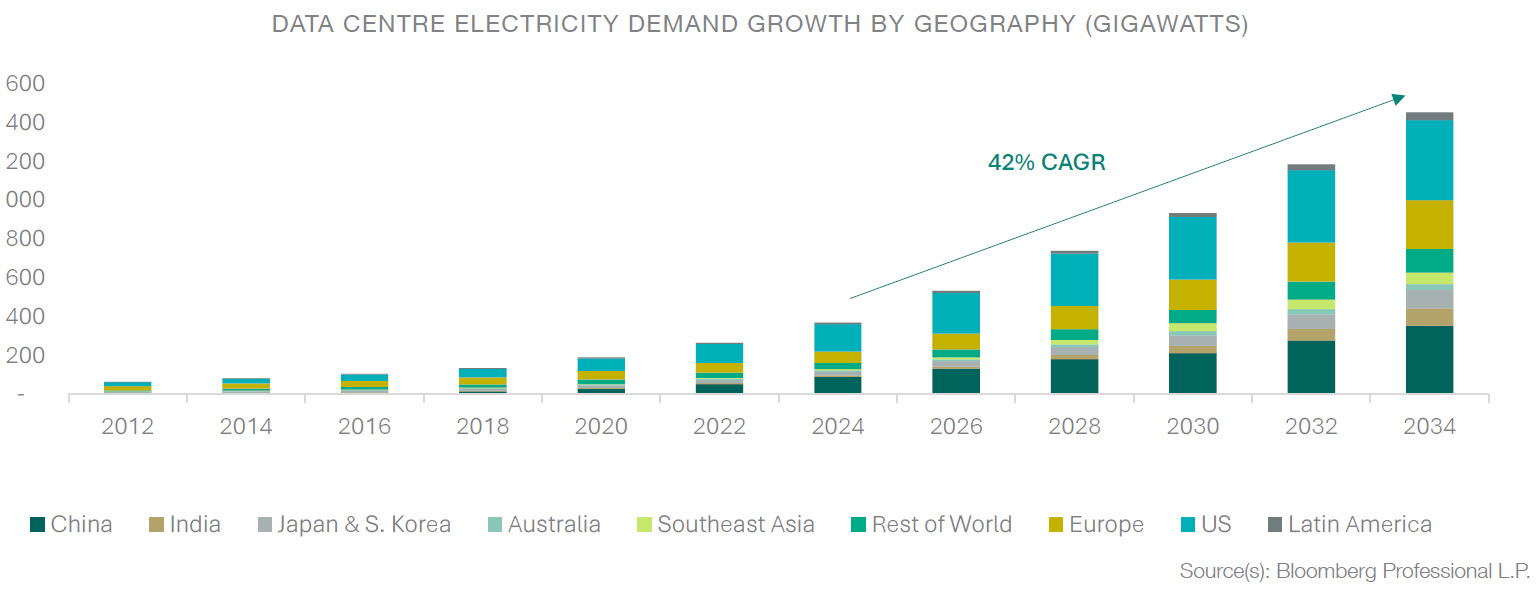
Data centres: a major accelerant
Data centres already account for around 3% of US electricity demand, but this figure is expected to rise to more than 8% by 2035, with similar increases in Europe.
Unlike traditional power users, data centres require a constant, 24-hour supply of electricity at near-full load. This places unprecedented pressure on power grids that were designed for fluctuating daily demand patterns. As a result, access to reliable power has become a critical constraint for technology companies and a key source of pricing power for electricity providers.
Supply response is a challenge
On the supply side, adding new generation and grid capacity is both capital-intensive and time- consuming. While renewable energy can be deployed relatively quickly, intermittency remains a challenge. Other solutions, such as gas or nuclear power, involve much longer development timelines. Today, amid surging demand, the waiting list for a gas turbine is now five years, and prices have increased by as much as 3x in the last 4–5 years. This imbalance between rapidly rising demand and constrained supply, and the ability to deliver it, is leading to tighter grids and structurally higher power prices.
For utilities, this environment is highly supportive. Capital expenditure plans have increased materially, with US utilities alone planning over USD 1 trillion of investments over the next five years. Because these investments are largely regulated or contractually secured, they offer a high degree of earnings visibility. As a result, earnings growth for US utilities is expected to nearly double compared with the previous decade, all while maintaining resilience across economic cycles.
We envisage some political risks to certain utilities in the US in 2026, as rising utility bills are becoming a political issue given that consumer bills are up 6–7% and are set to rise further next year. This challenge is most likely to arise in north-eastern US states on the largest grid, Pennsylvania–New Jersey–Maryland (PJM), that has seen the most data centres developed. Southern states (e.g. Texas and Louisiana) are less likely to suffer the same challenges.
While we expect a lot of political noise in 2026 in the US, government interference would inflict economic self-harm. If returns are insufficient to justify it, investment will be cut and grids will become tighter and less reliable. Some grids are managing data centre demands well by making new large loads pay up rather than cause consumers to pay more. The reality is that power generation and grid capacity are needed and, if not paid for, then investments will fall short of requirements, and access to power (at a reasonable cost) is a common denominator across all economies and is the lifeblood of AI.
In Europe, the same degree of market tightness has yet to be seen, but there is a growing momentum for data centre deployment. Furthermore, the same themes around years of underinvestment and rising power demand are set to support a growth dynamic not seen in decades driven by an investment need and sustained power prices. Today, we note that EU governments are even competing to attract investment and have consequently moved from penalising and squeezing the power supply chain to improving incentives to invest.
Satya Nadella, Microsoft CEO said in a 12 November D2G podcast: ‘The biggest issue we are now having is not a compute glut, but it’s power. It’s sort of the ability to get the builds done fast enough close to power,’ and, ‘It’s not a supply issue of chips; it’s actually the fact that I don’t have warm shells to plug into.’ (A ‘warm shell’ in this context refers to a built data centre (DC) with all utilities needed, notably power.)
From an investment perspective, US utilities offer direct exposure to data-centre-driven demand growth, while European utilities provide attractive income and defensive value. But the theme of power demand is broad, with numerous actors set to benefit from the capital spend building up. Industrial companies that supply key equipment, e.g. wires, transformers and turbines, are seeing record order books extending years into the future and which are supportive of margin expansion as well as earnings visibility. Power-generation technology providers in batteries, solar, etc. are similarly benefitting. Furthermore, raw materials used in the infrastructure chain and to generate power, such as gas, copper and aluminium, are also participating in this theme.
Read our Investment Outlook 2026 for more insights.
The financial instruments and investment strategies portrayed in this document are for informative purposes only. They may differ from those effectively held in an investor’ portfolio. Depending on the jurisdiction and investment profile, one or some of these instruments and strategies – including, where applicable, options – may not be permitted, available or suitable. The opinions expressed herein are correct as at 19 January 2026 and are subject to change without notice. Any forecast, projection or target, where provided, is indicative only and is not guaranteed in any way.


.jpg)