Headlines about a potential ceasefire in the Middle East have started to appear, though visibility on the geopolitical outcome remains limited.
With the duration of the disruption to global oil flows still a key variable, investors will be closely watching macroeconomic data due out in the coming week for early signs of the shock’s economic impact, alongside a self‑imposed US deadline of 7 April at 8 p.m. (US EST) of a possible deal.
Market recap
Beyond the numbers
Macroeconomics
The latest data suggest the United States entered the conflict in the Middle East on a firm footing. Consumers kept their wallets open in February: headline retail sales rose 0.6% month-on-month, while the control group (i.e. the inputs that feed directly into gross domestic product (GDP)) climbed 0.5%.
Confidence is also holding up better than expected, as consumers appear to be taking heart from upcoming tax cuts, which they hope will cushion the blow from higher energy prices.
The US economy added 178,000 jobs in March, beating expectations and rebounding from a revised loss of 133,000 in February, though the headline was flattered by healthcare workers returning from a strike, and the three-month trend averaging just 68,000 additions per month paints a more subdued picture. The Job Openings and Labor Turnover Survey (JOLTS) data reinforced the softening tone, with openings slipping to 6.9 million in February and the hiring rate falling to 3.1% – its lowest since the Covid-19 pandemic.
On the industrial side, March’s Institute for Supply Management (ISM) index rose more than expected to 52.7 from 52.4, confirming the signals coming from the Purchasing Managers’ Index (PMI) of moderate growth in the sector. However, the headline surprise came with a caveat: manufacturers are increasingly worried about looming price pressures and fresh supply-chain snags as delivery times lengthened; prices paid jumped from 70.8 to 78.3, reminiscent of 2022’s inflation surge.
While the US is still awaiting its first post-conflict inflation print, the eurozone’s headline numbers are already feeling the heat. The Old Continent saw its steepest monthly inflation jump since 2022, with prices up 1.6% month-on-month, driven almost entirely by a surge in energy prices, albeit still coming in slightly below expectations. Nevertheless, core pressures remain contained, giving policymakers reason to keep things on hold.
The final eurozone manufacturing PMI signals resilience in aggregate output, but masks divergence across countries, and growing concerns across the region: sentiment declined sharply in Spain and to a lesser extent in France, while it improved in Germany and Italy.
This week will offer a clearer read on how the conflict in the Middle East is shaping services sentiment in the eurozone; it will also see America’s first inflation print since the military action in the Middle East began, and preliminary publications of consumer sentiment for April.
Equities
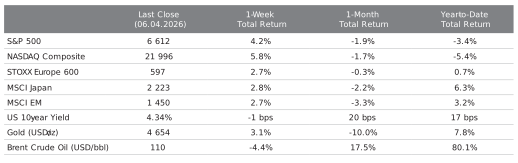
Global equities rebounded last week, with the MSCI ACWI up +3.0% (total return), amid tentative signs of a de-escalation in the Middle East.
At the start of the week, US President Trump suggested a willingness to wind down US military involvement in Iran within two to three weeks, sparking a global relief rally. However, midweek, Trump failed to provide a clear timeline and ramped up escalation rhetoric once again, pushing oil prices higher and leaving investors clinging to early-week gains.
US and European equities rebounded the most, with the S&P 500 up +3.4% and STOXX 600 up +3.8%, respectively, the former being boosted by the Magnificent 7, which rose +5.0%. Energy was the sole sector to finish the week in negative territory, down -2.8%, which was a small dent to its outsized year-to-date gains (+31.2% versus global equities at -1.6%).
Reports that Iran is drafting a protocol with Oman to monitor vessels transiting the Strait of Hormuz, and that it may be looking to set tolls for transiting the Strait, helped provide some stability to markets at the end of the week. With the key variable remaining how long global oil flow disruption will last, investors will be closely watching a self-imposed US deadline of a deal of 7 April (8 p.m. US EST), in addition to macro data set to be released in the week ahead, early signs of the disruption’s impact in March, namely US inflation, and the implications for earnings and growth estimates in the quarters ahead.
The Magnificent 7 led the charge, rising 5.0% amid an equity rebound.
Fixed income
Hostilities in the Middle East are now entering their fifth week. Headlines about a potential ceasefire have emerged, with talks reportedly taking place, but virtually no visibility on the geopolitical outcome is being offered by either side. Markets appear to have settled into an uneasy equilibrium, pricing in disruption but not escalation.
Against this backdrop, positive returns were posted across all major fixed income sub-classes, breaking a streak of four consecutive negative weeks for all segments, the longest since the ‘Taper Tantrum’ of 2013. Rates were broadly unchanged, while spreads tightened. Treasuries returned 0.3%, investment grade (IG) 0.6%, additional Tier 1 securities (AT1s) 0.7%, emerging markets (EM) 0.8% and high yield (HY) 1.2%.
The rally was driven by spread tightening, with IG narrowing by 4 basis points (bps) and HY an impressive 35 bps. While this weekly reversal is welcome, the bigger picture deserves attention: IG and HY spreads are now essentially flat since the start of the conflict in the Middle East. Five weeks into a conflict that has closed the Strait of Hormuz, sent oil above USD 100, and triggered massive supply disruptions, credit markets are pricing in remarkably little permanent damage, which might look complacent. Should the Strait of Hormuz remain effectively closed to shipping, and valuations begin to reflect the risk of demand destruction, and de-risking could materialise quickly, a scenario for which spreads at current levels offer little compensation. A defensive stance therefore continues to be favoured, with cash and low-duration Treasuries emphasised across portfolios.
AT1 spreads also tightened, though they remain more than 30 bps wider since the start of the conflict, a reminder of just how tight valuations were before the conflict began. In emerging markets (EM), spreads are 20 bps wider since the onset of hostilities, with the Middle East region out by around 60 bps, as would be expected given its direct exposure to the conflict.
A growing divergence in central bank reactions was the most notable macro development of the week. Federal Reserve Chair Powell, speaking at Harvard University, drew a clear line in the sand: anchored inflation expectations allow the Fed to look through supply shocks. The impact was immediate, with markets moving from pricing in a 50% chance of a hike by December to a 20% probability of a cut. The European Central Bank (ECB) and Bank of England (BoE) struck a different note: ECB President Lagarde signalled readiness to hike even if the inflation overshoot proves temporary, and almost three ECB hikes and two BoE hikes are now priced in for this year. Even so, BoE Governor Bailey pushed back, telling Reuters that traders were, ‘getting ahead of themselves’, citing a softening labour market and limited business pricing power. This divergence matters: patience from the Fed, preparation from the ECB, and a BoE caught in between, acknowledging inflation risks but wary of compounding an already fragile growth outlook.
A defensive stance is favoured in fixed income, with cash and low-duration Treasuries being the preferred holdings
Private credit
Private credit, and more specifically the sub-segment of sponsor-backed direct lending wrapped in vehicles offering quarterly liquidity, continues to be in the spotlight, as illustrated last week by Blue Owl. Two of its non-traded business development companies (BDCs), namely Blue Owl Technology Income Corp and Blue Owl Credit Income Corp, received redemption requests of 41% and more than 20%, respectively. Blue Owl is, to date, the private credit platform facing the harshest liquidity stress, after the botched merger in November of Blue Owl Capital Corporation II (OBDC) and its subsequent poorly telegraphed liquidation earlier this year. The liquidity stress witnessed since late last year continues unabated across all non-traded BDCs, interval funds and evergreen vehicles, and is unlikely to stabilise anytime soon, as unmet redemptions contribute to the creation of redemptions queues, triggering a self-reinforcing feedback loop.
So far, stress has been contained on the limited partner (LP) liquidity side of the equation, but it is not unlikely that things will develop, as illustrated by the case of software as a service (SaaS) company Medallia that emerged late last week. Medallia has become a stressed software buyout: Thoma Bravo bought it in 2021, but performance has been weaker than anticipated and led Blackstone and other lenders to mark down the debt, although to varying degrees.
Last week, the same lenders refused to provide another round of rescue financing, with the situation now being a showdown between the equity sponsor and the lenders. Thoma Bravo, the sponsor, may need to inject fresh equity, or Medallia could be restructured in a way that hands more control to creditors led by Blackstone. This will likely become one of the biggest sponsor-versus-lender workouts of the past few years.
While LP liquidity stress remains contained, the situation may evolve, as illustrated by the case of the SaaS company Medallia, which is going through a sponsor-versus-lender showdown.
Forex & Commodities
Last week, the majority of G10 currencies traded in tight ranges. The US Dollar Index edged higher following the publication of better-than-expected US non-farm payroll (NFP) data for March. The data were unequivocally constructive for the greenback, and investors increased net USD long positions.
The main event risks for the USD over the coming week are the publications of consumer price index (CPI) and personal consumption expenditure (PCE) inflation data. US CPI data for March are expected to print at 3.4% year-on-year (headline) and 2.7% year-on-year (core). The publication of the minutes from the latest Federal Open Market Committee (FOMC) meeting should also garner some market interest. Overall, the USD should maintain a modest bid in the short term, until markets gain more clarity on the situation in the Middle East.
The USD/JPY traded higher to levels of just under 160, and several Bank of Japan (BoJ) officials stepped up their spoken interventions, intending to reduce upside appreciation pressure. The main event over the coming week will be the publication of labour earnings data. At the latest BoJ meeting, confidence was expressed in underlying wage-setting behaviour, paving the way for eventual BoJ rate hikes.
Gold traded at levels of just under USD 4,700 per oz for most of the week, with the short-term outlook remaining contingent on developments in the Middle East. An early end to the conflict would be constructive for gold, because it would reduce central bank interest rate hiking expectations, and, in turn, reduce real interest-rate expectations. A protracted conflict would prevent aggressive upside in the near term. Our long-term outlook for gold remains highly constructive.
The short-term outlook for gold hinges on developments in the Middle East, but remains highly constructive over a longer horizon.
The opinions expressed herein are correct as at 7 April 2026 and are subject to change without notice. This information should not be relied upon by the reader as research or investment advice regarding any particular fund, strategy or security. Past performance is not a guide to current or future results. Any forecast, projection or target, where provided, is indicative only and is not guaranteed in any way.