The recent escalation in the Middle East has materially changed the tone of markets and prompted us to revise our base case scenario, notably on energy.
Key messages
- Energy: The average Brent crude price is now forecast at USD 100 per barrel over the coming quarters, leading to an upgrade of our conviction on oil.
- US dollar: Higher oil prices and the postponement of Federal Reserve rate cuts are set to support the greenback.
- Cash: Against a volatile environment, cash preserves flexibility and improves portfolio resilience.
- Hedge funds: Among the asset class, several strategies may benefit from rising market volatility.
Oil shock reshapes the macroeconomic outlook
More than a month into the Middle East conflict, early signs of back-channel negotiations are beginning to emerge between the belligerents. While visibility remains limited, adverse macroeconomic signals continue to mount, putting global economic resilience to the test.
Disruptions in oil markets are expected to become apparent in inflation data from March onwards. The sharp rise in spot oil prices is pushing costs higher and is now set to broaden into wider inflation dynamics.
Given this backdrop, our central scenario has been revised. In the near term, inflation could rise to the 3.0–3.5% range in the euro area, and to around 4.0% in both the US and the United Kingdom. At this stage, the inflationary impulse is expected to outweigh the drag on growth, estimated to be at around 0.5–0.7 percentage points.
Central banks are responding with a markedly more cautious stance. As inflation concerns intensify, the risk of renewed monetary tightening across major economies is rising, which would, in turn, deepen the fragmentation of global growth.
The overall impact of the oil shock remains closely tied to both the duration and the outcome of the conflict. For now, Europe and emerging markets are poised to bear the heaviest burden.
Macroeconomics
How the conflict in Iran reshapes the global outlook
The global economy is once again confronting an oil shock amid a major geopolitical crisis. The conflict in the Middle East is becoming protracted, with mounting tensions over oil prices as the Strait of Hormuz remains closed. After a month of hostilities, rumours of talks between the parties involved are emerging, yet the outcome remains highly uncertain.
Concerns about stalling growth and renewed inflation are being reignited by parallels with the
major energy crises of 1979 and 1980, as well as the 2022 crisis linked to the Russia-Ukraine conflict. While financial markets are experiencing volatility, the economic impact will likely be gradual yet significant, prompting a reappraisal of growth and inflation forecasts for 2026.
Oil prices, inflation and growth: The shocks ahead
Global industry has become less sensitive to energy prices over the past few decades; even so, oil remains pivotal. Oil prices directly affect consumers, while oil remains an essential component in many products across industries such as fertilisers and petrochemicals. These sectors now face supply challenges amid the ongoing crisis.
The rise in spot oil prices has led to higher petrol prices, including in the US. This shock is expected to appear in price indices from March onwards, with a sharp acceleration in inflation anticipated in the second quarter. Based on our estimates, which consider the increases in Brent crude observed in recent weeks, the additional inflationary pressure is expected to be close to a full 1 percentage point (pp) over the year. The trend observed at the end of last year, which pointed towards stabilising global inflation at around 2.5%, has reversed, paving the way for prices to rebound into a 3.0%–4.0% range in the coming quarters.
Energy-importing economies, notably Europe, Japan and several Asian countries, are likely to prove more vulnerable than the US to a resurgence in inflation. In the near term, inflation could rise to around 3.0–3.5% in the eurozone and around 4.0% in both the US and the United Kingdom (UK) in the coming months. Looking at the annual averages for 2026, inflation is forecast to reach 3.5% in the US, 3.8% in the UK, and 3.0% in the eurozone. Across Asia, inflation is expected to rebound in most countries. Notably, it is projected to reach 4.7% in India and 2.5% in China, which would therefore abruptly emerge from deflation.
In the short term, the inflation shock appears to be greater than the expected drag on growth. Our scenario anticipates a reduction in 2026 growth of approximately 0.5–0.7pp, compared with the 1 pp rebound in inflation. Energy-importing countries face the greatest exposure, with potential losses exceeding 0.5–0.7 pp, while the US and China would be the least affected. This shock will erode economic agents' confidence in the short term, weigh on real household incomes, and could lead to the deferral of corporate investment and hiring decisions. As a result, global growth could slow to 2.7%, with US growth moderating to 1.9% and China to 4.5%, while Europe and Japan are expected to see growth in the range of 0.1% to 0.6%.
Despite threats of a trade war and rising US tariffs, growth proved resilient in 2025. While that resilience may hold up in the short term, disruptions to trade flows and the surge in energy prices are placing the economic cycle under strain. The risk of a return to a stagflation regime, as seen in the 1970s, remains distant, but it is rising and constantly evolving depending on the duration and outcome of the conflict.
Central banks turn less accommodating amid rising inflation concerns
Mindful of the inflationary shock experienced in 2022, central banks are seeking to prevent any sustained increase in inflation expectations. Strong demand and rising energy prices triggered an inflationary spiral at that time, which took central banks some time to bring under control. As a result, their recent communication have been more hawkish than expected, as they aim to prevent any further inflationary spiral, even though key interest rates remained unchanged at their latest meetings.
This vigilance regarding inflation has already led money markets to anticipate key interest rate rises in 2026. Even though financial conditions in the markets have already deteriorated, there is a significant risk of monetary tightening in the second quarter, particularly in the UK and the eurozone, which would contribute to greater growth fragmentation across regions and countries.
US INFLATION

Potential risk scenario
What can 50 years of oil shocks teach us?
The conflict in the Middle East has triggered an initial supply shock to the global economy, echoing the energy shocks of previous decades. In terms of magnitude, the current conflict represents an initial disruption of close to 6.0–8.0% of global demand, comparable to the 1973 OPEC oil embargo, the 1979 Iranian Revolution, and the 1990 invasion of Kuwait by neighbouring Iraq. By contrast, more limited supply shocks in the 21st century include the 2003 US invasion of Iraq and Russia's 2022 invasion of Ukraine.
The impact and duration of these shocks on energy prices have varied. At their peaks, prices doubled during 20th-century energy shocks, while emergency supply responses were muted. However, following the three-month spike after the 1990 invasion of Kuwait, crude oil prices peaked and then gradually returned to their pre-invasion levels over the subsequent nine months. Russia's 2022 invasion of Ukraine saw a similar initial spike followed by a decline in the months that followed. The 2003 US war with Iraq saw a different dynamic, with increased supply ahead of the conflict cushioning the loss of Iraqi output.
The duration of the rise in oil prices helps explain the differing performances of equity markets across these oil shocks. The permanent increase in oil prices, from USD 3 per barrel to over USD 10 per barrel, resulting from the oil shocks of the 1970s triggered a valuation de-rating in the S&P 500, from 15–20x in the 1960s to post-crisis troughs in the 1970s averaging around 7x trailing earnings.
In contrast, the transitory supply shocks that followed saw S&P 500 valuations bottom out at an average of around 16x.
While the likelihood of a prolonged oil shock appears to be growing, and even though such an outcome is not a foregone conclusion, the risk-reward facing investors points towards further price-to-earnings (P/E) compression to more durably price in even a transitory rise in oil prices. For investors, this suggests that a wealth-preservation-focused approach during this period of uncertainty remains warranted.
Asset allocation
Equities
Shift in market dynamics
The recent military escalation in the Middle East has materially changed the tone of markets. Several trends that had been firmly in place since the start of the year, including non-US equity outperformance, cyclical leadership, and dollar weakness, have stalled abruptly. Regions most exposed to imported energy, particularly in Asia, have seen the sharpest reversals. At sector level, energy has outperformed strongly, while consumer staples, metals, and mining have come under pressure.
Valuations have adjusted, but only partially. Multiples have compressed across most regions and are now closer to historical averages, though this likely marks only the first stage of repricing. Earnings will be the key area to watch. Consensus expectations for 2026 have continued to rise despite the weakening macroeconomic backdrop. However, history suggests this may prove too optimistic, as energy shocks typically affect macro data and earnings with a lag.
Fixed income
Geopolitical tensions drive fixed income sell-off
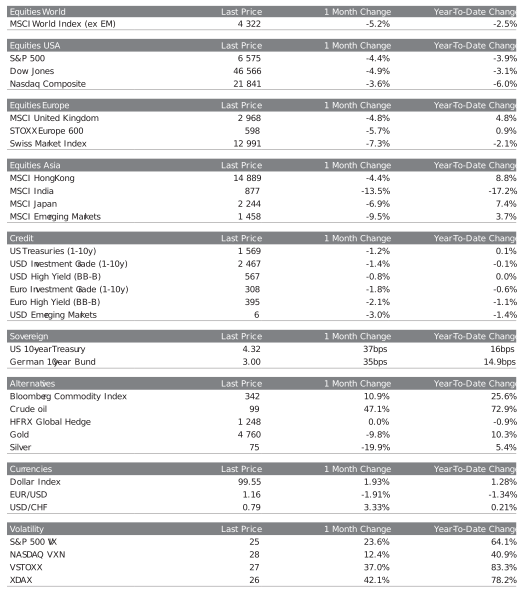
March was all about the US-Israel military campaign in Iran. The fallout spared no corner of fixed income, as Treasuries lost 1.1%, investment grade (IG) 1.4%, high yield (HY) 1.1%, additional Tier 1 (AT1s) 2.4%, and emerging markets (EM) 3.3%, sending year-to-date returns into negative territory.
The most important dynamic of the month was the failure of government bonds to act as a hedge, overwhelmed by oil quickly surging past USD 100 per barrel following the effective closure of the Strait of Hormuz. From that point on, the driver was inflation expectations, not safe-haven demand, and the sell-off in rates became broad-based. For the month, US 10-year yields rose by 38 basis points (bps), Bunds by 36 bps, and gilts bore the brunt with a 68-bp increase, the most since the September 2022 mini-budget crisis. Although the last week of the month provided some relief, gilts traded above 5% during the month, a level last seen in 2009, while Bund surpassed 3% for the first time since 2011. Year-to-date, rate changes are more contained than the monthly figures suggest, with US 10-year Treasuries and Bunds up by 15 bps, and gilts up by 44 bps, which is a reminder that rates had rallied sharply in February before reversing course.
Given the magnitude of the moves in rates and equities, credit spreads remained surprisingly well-behaved: IG widened only 20 bps from the January lows, HY by 90 bps, and AT1s by 60 bps, all still below their respective 10-year averages and at undemanding levels. This combination of rising rates and widening spreads, both moving against fixed income simultaneously, remains rare. In fact, the last occurrence of four consecutive weeks in which all sub-classes posted losses was during the summer of 2013's ‘Taper Tantrum’, when Ben Bernanke signalled that the Federal Reserve might begin tapering quantitative easing (QE) purchases, sending the US 10-year from 1.6% to 3.0%, while spreads widened at the same time. Then, as now, the typical inverse relationship between rates and spreads broke down.
The shift in rate expectations has been dramatic. At the start of the month, markets were debating the timing of the next cut. By month-end, the question became how many times the European Central Bank (ECB) and Bank of England (BoE) might hike. Federal Reserve (Fed) pricing moved from two cuts to a 50% probability of a cut, the ECB from a 50% chance of a cut to two to three hikes, the BoE from two cuts to two hikes, and even the Swiss National Bank went from some likelihood of a cut to one hike being priced in.
With oil above USD 100, the Strait of Hormuz effectively closed, and central banks caught between weaker growth and an energy-driven inflation shock, elevated volatility and a risk premium on rate-sensitive assets remain the base case. Until there is greater clarity, a more conservative stance is warranted.
Hedge funds
Exploiting volatility
Geopolitical events have triggered significant reversals in recent price trends, as asset prices are temporarily driven by technical factors, such as investors requiring liquidity and/or risk controls, leading to automatic position selling. Government bond markets are currently experiencing these conditions, with spread trades across yield curves and in futures markets widening, which may provide a suitable entry point for fixed-income-focused strategies.
Within credit markets, convertible bond arbitrage remains attractive: nominal GDP growth continues to support the credit quality of issuers typically held in the portfolio. Meanwhile, elevated single-stock volatility in equity markets increases the value of the equity option component embedded in convertible bonds, which is a component the strategy actively hedges. This dynamic, which can be termed ‘volatility yield’, remains at elevated levels. Finally, healthy issuance volumes provide greater reinvestment opportunities and tend to cheapen the secondary market, offering more attractive entry points.
In equity markets, beta exposure is more efficiently captured through long-only approaches rather than equity long/short strategies. Our preference is for alpha-capture strategies that benefit from high single-stock dispersion driven by individual company fundamentals. Significant dispersion across stocks, sectors, regions and countries is expected, which should create a positive opportunity set for the strategy. To achieve this, equity beta should remain negligible and portfolio turnover high relative to traditional buy-and-hold approaches.
Among diversifying strategies, short-term trading models with a holding period of five to ten days, have benefited from sustained higher levels of market volatility, as the greater number and frequency of price movements increase system turnover and thus the ability to capture positive returns.
Private markets
Dark clouds over private wealth vehicle
The private credit evergreen ecosystem is entering a new phase. Redemption pressure across non-traded business development company (BDCs) and open-ended direct lending vehicles accelerated sharply in Q1 2026, with outflows running at roughly twice Q4 levels with some astonishing figures from Blue Owl, with Owl Creek Investment Corporation (OCIC) at over 20% of redemptions, while the Owl Tree Investment Corporation (OTIC) has received more than 40% of requests.
January and February net asset value (NAV) marks on several prominent vehicles have turned negative, which is an early signal that vehicle-level stress is beginning to interact with portfolio valuations.
The vertical transmission mechanism is now active: persistent redemptions trigger gating, gating halts new subscriptions, and structurally negative net flows force managers into liquidity generation that compresses portfolio returns. Financing counterparties are tightening, and BDC bond spreads are widening. Critically, the stress remains concentrated at vehicle level. Asset quality has not broadly deteriorated for now, but the distance to that threshold is narrowing and dark clouds are now hovering over direct lending packaged in semi-liquid vehicles.
Currency
Higher oil prices are set to weigh on the EUR and JPY
In March, both the EUR and JPY weakened against the USD. Their respective weakening reflected higher oil prices, which resulted in a negative terms of trade shock. The prospect of higher oil prices for a prolonged period implies that both the EUR and JPY should experience a reduction in their respective trade balances, leading to a weaker profile for both and slightly stronger USD exchange rates.
The USD/CHF rose to levels of around 0.80, reflecting USD appreciation. The CHF also tends to weaken during the initial phase of oil price shocks, reflecting weakening trade balance effects, but CHF weakness should not be a protracted affair. The overnight swap index (OIS) market has moved to price in a full 25-bp Swiss National Bank (SNB) rate hike by year-end.
Commodities
Gold and silver pulled back
Gold fell from highs of around USD 5,450 per oz to lows of USD 4,100 per oz over the month of March. The decline reflected portfolio risk reduction by both institutional and retail investors, who held large, long gold positions at the start of the month. This price action is typical of the initial period of a crisis, when investors prize liquidity management. Gold and silver subsequently stabilised at levels above USD 4,500 per oz and USD 70 per oz, respectively. In addition, both institutional and retail positioning has declined dramatically, reducing short-term downside potential.
The outlook for both metals is highly contingent on the longer-term economic scenario. If markets move to price in a stagflation scenario, as defined by low growth and high levels of inflation, this should be highly constructive for precious metals, as was the case in the mid-1970s and early 1980s.
Market monitor
As at 1 April 2026
To download the full PDF, please contact your relationship manager or reach out to us via the form by clicking here.
The financial instruments and investment strategies portrayed in this document are for informative purposes only. They may differ from those effectively held in an investor’ portfolio. Depending on the jurisdiction and investment profile, one or some of these instruments and strategies – including, where applicable, options – may not be permitted, available or suitable. The opinions expressed herein are correct as at 2 April 2026 and are subject to change without notice. Any forecast, projection or target, where provided, is indicative only and is not guaranteed in any way.