With another US regime change operation under way in Iran shortly after the more limited, successful January operation in Venezuela, questions are once again being asked.
Foremost among these is whether the United States’ focus on other parts of the world may either encourage or provide an opportunity for China to move more proactively against Taiwan.
The argument is that the US’s military and global powers are currently stretched: the country is engaged in Venezuela, supplying arms to Ukraine via Europe, and is now actively involved in Iran. The US has redeployed the USS Abraham Lincoln aircraft carrier battle group, which was previously on station in East Asia, to the Middle East.
However, in our view, at least two constraints remain in place against China taking action.
The US has spent the years since Trump 1.0 rebuilding capabilities among its allies, notably Japan, Australia, and the Philippines. While these are certainly not enough for a prolonged conflict with China, they likely remain sufficient as a short-term deterrent against a Chinese move against Taiwan. For example, the US has 250 combat aircraft including its most advanced F-35s deployed to the Middle East. In comparison, Japan alone is operating more than 40 F-35s with an additional 110 – including carrier-capable aircraft – set to be delivered by Mitsubishi Heavy Industries. This leaves Japan with the largest fleet of F-35s outside the US.
Moreover, Japan now operates two light aircraft carriers – the JS Kaga and JS Izumo – while nine military bases and pre-positioned troops and equipment in the Philippines are beginning to fill roles that were previously delivered by US aircraft carrier battlegroups.
Beyond this, Iran may provide an opportunity for China to see how its own modern military equipment performs in battle. 2025 provided a limited preview of its air and missile capabilities during the border clash between Pakistan and India. It is worth recalling that Pakistan, the only nation besides China operating the J-10 fighter and its PL-15 long-range air-to-air missiles, successfully engaged and shot down French-made Rafale jets of the Indian air force.
Prior to last weekend’s attacks, China had reportedly been delivering military equipment to Iran, which included kamikaze drones and air-defence capabilities. Moreover, Iran was negotiating to buy China’s advanced anti-ship missiles which have contributed to a change in the US’s aircraft carrier strategy in East Asia. It remains unclear if these missiles have been delivered.
While it is admittedly the early days of the conflict, the ‘best-case’ scenario for China is that these capabilities have not yet been deployed by Iranian forces. Alternatively, radar systems, particularly air defence networks, may have proven ineffective against the initial US/Israeli strikes.
If the former is the case, China would probably wish to see how its equipment performs on a larger battlefield against US equipment and tactics deployed in the Gulf. This could come at later stages of the current conflict if the capabilities have not already been engaged. If the latter is the case, a unilateral move by China against Taiwan employing similar equipment would likely pose an unattractive risk-reward profile for China as things stand.
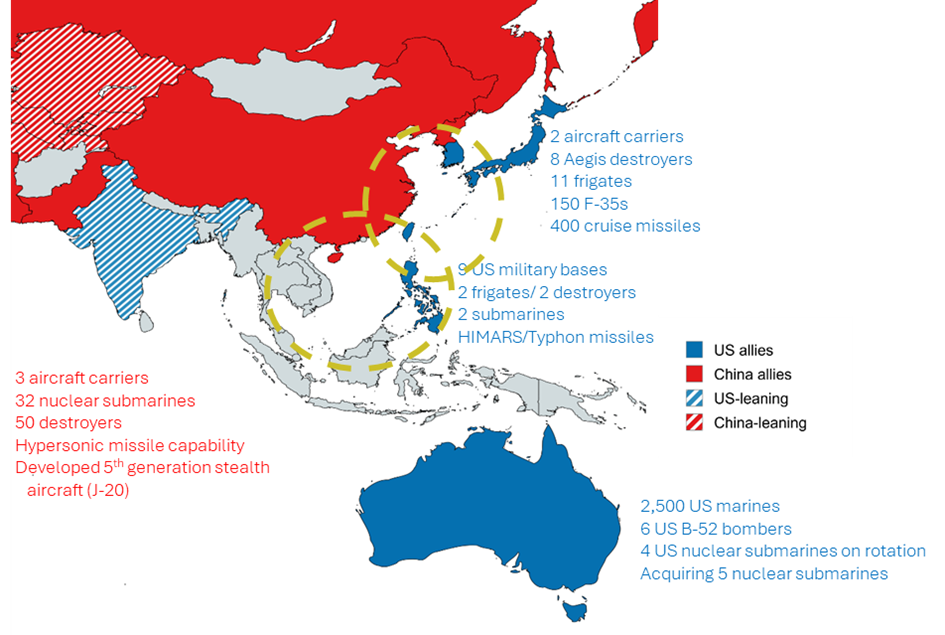
While China could view the US military as currently being stretched, it is far from clear that the risk-reward of a unilateral move by China against Taiwan is sufficiently attractive to prompt China to seek to proactively change the status quo across the Taiwan Strait. A more attractive risk-reward strategy for China may be to continue buying time and allow the US military to deplete its stocks of, for example, missiles and interceptors, while seeking to close any capability gap, perhaps seeing their equipment prove their capabilities in Iran.
Indeed, by delivering military hardware to Iran while limiting/slowing the US’s ability to restock weapons by constraining the commodities channel (e.g. the supply of rare earth metals), Iran could become a quagmire for the United States, much like Iraq and Afghanistan were previously, and, more recently, like Ukraine has become for Russia.
Against this backdrop, we continue to believe that proactive risk management remains paramount for investors. Three developments on the horizon bear watching to calibrate how these risks continue to unfold:
- The Xi-Trump summit at the end of March.
- The US arms deal with Taiwan remains suspended until the Xi-Trump summit.
- Japan’s increased defence spending post-elections.
Following its actions in Venezuela and Iran, and its rhetoric surrounding Cuba and even Greenland, the Trump administration has moved rapidly to execute the roadmap outlined in the president’s November 2025 National Security Strategy following the agreement reached between Xi and Trump in Busan, South Korea in late 2025.
The Xi-Trump summit may provide the first indication of China’s strategic response to the unfolding of the American National Security Strategy, as well as to the changing security dynamics in East Asia following the potential conclusion of the Taiwan arms deal and Japanese Prime Minister Takaichi’s post-election defence spending plans.
If China concludes that the US and Japan are themselves changing the status quo in East Asia to its detriment, China may revise the thinking described above.
The opinions expressed herein are correct as at 3 March 2026 and are subject to change without notice. This information should not be relied upon by the reader as research or investment advice regarding any particular fund, strategy or security. Past performance is not a guide to current or future results. Any forecast, projection or target, where provided, is indicative only and is not guaranteed in any way.