Could social unrest and the fiscal deadlock in France trigger a systemic crisis in the euro area?
A turbulent presidential election campaign, social unrest and the fiscal impasse in France bring back memories of some of the most challenging periods in the euro area’s economic history: soaring debt and deficits, the Greek sovereign debt crisis, bank failures and interventions by the ‘Troika’ in countries facing financial difficulties. These concerns have resurfaced amid mounting pressure on French government bond yields. The current period of instability highlights the important choices France is facing, with the country remaining uncertain about the direction of its economic and social model. However, the euro area has emerged stronger from successive crises and, despite the many challenges ahead, has the tools needed to navigate this period without slipping into another systemic crisis.
The euro area: a cautious growth outlook for 2027
Euro area growth managed to remain above its potential rate over the first three quarters of 2026, recording a surprisingly resilient 1.3% year-on-year expansion. France (-0.1% year-on-year) and Italy (0.8%) nevertheless lagged behind in the third quarter, while economic activity remained robust in Spain (2.7%), Germany (1.2%), the Netherlands (2.1%) and Ireland (3.6%).
Our outlook for the European economy in 2027 is more cautious than the consensus forecast. The growth momentum accumulated by the third quarter therefore provides a welcome buffer for 2027, at a time when downside risks continue to build.
Headwinds to growth gathering in 2027
Economic conditions are likely to become less favourable over the coming quarters, reflecting the continued energy shock, tighter financial conditions, a deteriorating political environment and fiscal uncertainty in France.
Nine months into the conflict in the Middle East, the energy shock is proving persistent, with oil, gas, and diesel prices likely to remain elevated until at least spring 2027. Supply constraints are also expected to persist as restrictions on shipping through the Strait of Hormuz and the Bab al-Mandab Strait continue to disrupt trade flows.
Against this challenging external backdrop, government spending has acted as a stabilising force in several countries over recent quarters and should continue to support growth, albeit at the expense of fiscal balances. Meanwhile, household consumption could weaken as purchasing power comes under renewed pressure and consumer confidence deteriorates. Labour market conditions have also weakened, with unemployment rates edging higher in many countries.
The European Central Bank (ECB) initially adopted a patient approach to inflation in Q2, emphasising the supply-side shock stemming from the conflict in the Middle East. However, resilient demand and a rebound in inflation to above 3% prompted the ECB to raise its key policy rates in June and again in September, bringing them to 2.50%. With the conflict dragging on and energy prices accelerating, further inflation peaks are expected towards the end of the year and in early 2027, potentially reaching around 4% year-on-year. To prevent higher energy prices from feeding through into core inflation and wages, the ECB could raise rates further in the coming months and this remains a risk rather than part of our central scenario. The ECB’s monetary tightening, combined with rising refinancing costs in bond markets (already equivalent to an additional 25 basis points (bps) of policy rate increases), could lead to a decline in both credit supply and demand in early 2027.
Political conditions have also deteriorated across several countries. In Germany, federal state elections have seen the national governing coalition lose ground to more radical parties in several regions, reflecting growing middle-class dissatisfaction with existing policies and reforms. Spain’s general election, scheduled for late November, could similarly reveal public discontent despite the country’s strong economic performance, and, according to the latest opinion polls, they could result in a change of government. The start of the presidential election campaign in France has exposed similar concerns, although tensions have been exacerbated by political manoeuvring and widespread public opposition to recent reforms.
Overall, governing coalitions in several countries appear fragile, and changes in political leadership are likely at upcoming elections. One risk is that the current instability persists, as these elections could produce minority governments and fragmented parliaments, thus undermining political and economic stability.
 2027 outlook: moderate growth expected, but downside risks warrant consideration
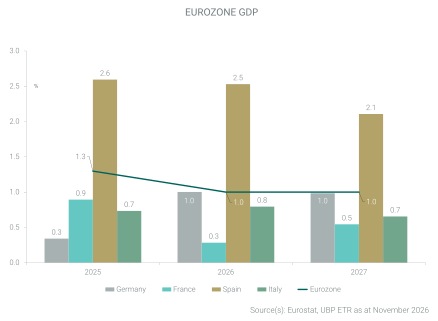
The consensus forecast points to an acceleration in euro area growth to 1.3% in 2027, alongside a recovery to around 1% in both France and Italy.
However, our central scenario is more cautious: the economic and political environment appears fragile, and euro area growth is likely – at best – to remain at around 1% in 2027, i.e. close to its 2026 pace. Under our scenario, growth in France and Italy would reach approximately 0.5–0.6% in 2027, while German economic activity could continue to expand at around 1%.
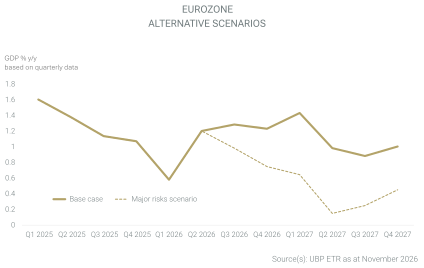
Beyond this central scenario, the accumulation of political, financial and energy-related pressures leads us to consider an alternative scenario involving a sharp slowdown in growth. Oil prices and interest rates remaining higher for longer than expected could weigh on economic activity and push the euro area towards a near-stagflationary environment. In this scenario, euro area growth would be limited to just 0.5% in 2027, with modest expansion in Germany (0.8%), very weak growth in Italy (0.3%) and stagnation in France. The probability of this scenario remains relatively low but could increase significantly if economic and political conditions deteriorate further.
 France, the sick man of Europe, facing weak growth and fiscal deadlock
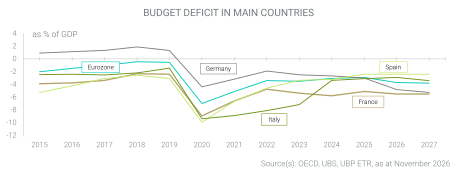
With growth expected to remain sluggish at 0.3% in 2026 and just 0.5% in 2027 in our central scenario, France faces a fiscal impasse. The stimulus measures introduced during the Covid-19 pandemic have kept public spending at elevated levels, while the budget deficit has remained on an upward trajectory. The savings envisaged in the government’s 2027 fiscal plan rely on expenditure restraint and cuts to pensions, healthcare and certain other areas of non-defence spending. On the revenue side, some corporate taxes are being extended, albeit at lower rates than in 2026, alongside stronger measures to combat tax fraud. The plan aims to reduce the deficit from 5.4% of GDP in 2026 to 5.0% in 2027. However, following the recent demonstrations, additional spending on education and measures to support household purchasing power – including an earlier-than-planned increase in the minimum wage – now appear likely. These measures could delay deficit reduction. Moreover, the scope for expenditure cuts remains limited without more far-reaching reforms or additional revenue given the substantial share of GDP accounted for by pension and healthcare spending.
Nevertheless, the euro area has important sources of resilience
The oil shock has not pushed the euro area into recession
Euro area growth has remained relatively robust over recent quarters despite the oil shock. Diversification of energy imports, government support and households’ use of savings to absorb higher energy bills have helped prevent the stagflationary shock that might otherwise have resulted from rising energy prices and shortages of fuel and petroleum-based inputs.
Germany and Spain are driving euro area economic activity
Economic conditions in Germany have improved, as reflected in order books and industrial production, supported by public-sector orders in defence, infrastructure and energy security. This should allow German growth to accelerate from 0.2% in 2025 to 1% in 2026. However, consumption continues to lag behind, as household confidence, as in other countries, has deteriorated following the latest increases in energy prices.
In Spain, growth has remained strong, with an expansion to 2.6% expected in 2026 and 2.1% in 2027. Economic indicators disappointed at the beginning of the second half of the year, but growth should remain on a favourable trajectory even after the general election, as the manifestos of the main candidates remain broadly supportive of economic expansion.
Defence, rather than artificial intelligence (AI), is driving investment, supported by the public sector
Euro area investment in new technologies and AI continues to lag well behind the United States and China, despite having increased in recent years. The euro area’s role in developing the AI ecosystem remains limited, consisting primarily of data centre construction and the production of specialised industrial equipment, particularly in the Netherlands and Ireland. France also began developing its strategy in 2018, followed by a plan in 2025 under the France 2030 initiative to support infrastructure and digital technologies.
Europe will remain heavily dependent on technologies developed in the United States, which requires sustained capital expenditure, particularly on infrastructure, as well as imports of US technology, which will weigh on GDP. Europe’s political ambition to develop a more autonomous defence strategy will encourage investment in proprietary semiconductor technologies and data-processing capabilities. Defence and aerospace could therefore provide the channels through which new technologies spread to other sectors of the economy.
Could these risks trigger another European crisis similar to that of 2010?
France in 2026 is not Greece in 2010
France is not Greece, although some parallels can be drawn, particularly regarding widening government bond yield spreads over Germany Bunds and the structural increase in public debt.
In 2010, Greece suffered from several serious shortcomings: unreliable statistical data, unrealistic fiscal forecasts – with the deficit revised from 8% to 15% of GDP and public debt reaching 130% – and the use of complex financial instruments to conceal debt, while structural reforms remained insufficient. Financial markets refused to continue financing the country despite interest rates rising to 35%. Several bailouts were required to restore Greece’s financial position and keep it within the European monetary framework despite widespread criticism but this allowed it to benefit from European support mechanisms. This came at a substantial social cost, including more than a decade of exclusion from financial market borrowing and dependence on the ECB.
France’s problem is primarily fiscal, with the main challenge lying in its difficulty in implementing the reforms that have been promised and that are necessary over the longer term. As the International Monetary Fund (IMF) has indirectly indicated, France is strong on commitments but struggles to implement reforms, frequently citing the risk that renewed domestic or external tensions could undermine growth and the public finances. Market financing remains available, but at an increasingly high cost. Projected over the next decade, this burden could become unsustainable for the country, with debt potentially reaching 130% of GDP by 2030 and debt-servicing costs rising to 4% of GDP. Current tensions in bond yields should therefore serve as a warning and encourage policymakers to take concrete action promptly to avoid the worst-case scenarios experienced by Greece and Cyprus.
What we are witnessing is therefore primarily a political and fiscal crisis in France, rather than a financial and institutional crisis affecting the euro area as a whole. Before the recent market tensions, the IMF considered the risk of a French sovereign debt crisis to be limited: according to the IMF, France benefits from a diversified economy and a sound financial system, supported by effective banking supervision. Both the Organisation for Economic Co-operation and Development (OECD) and the IMF acknowledge France’s resilience in their 2026 assessments, despite the risks and external constraints it faces.
Furthermore, although US, Russian and Chinese leaders have at times appeared to favour a weakening or fragmentation of the euro area, critics have repeatedly underestimated the strength of the European political project and public support for the single currency. Recent social and financial tensions have once again prompted some observers to suggest that the euro area may be entering the ‘beginning of the end’, despite the resilience demonstrated by monetary union.
The euro area: an unfinished project with structural weaknesses
The euro area remains a monetary union whose integration is incomplete in several areas, and one with important structural issues still unresolved. Nevertheless, successive crises have strengthened the monetary union, while external challenges have generally reinforced the rationale for closer integration.
Over the medium term, the most pressing structural challenges are an increasingly ageing population, limited innovation, weak productivity gains, and the resulting erosion of potential growth over recent decades. Although the European domestic market is comparable in size to – or even larger than – that of the United States, its potential growth rate remains below that of its major economic partners, representing a significant competitive disadvantage. The IMF estimates potential growth in the euro area at around 1%, a figure broadly similar to that of France, although this may still appear optimistic given the structural constraints. Depending on the policy strategies adopted by European and French authorities, IMF scenarios suggest that potential growth could range from 0.6% to 1.4% for both the euro area and France.
European monetary union was established more rapidly than genuine economic convergence among its member states, reflecting the political ambitions of European leaders at the time. As a result, several areas still require further integration, including fiscal harmonisation and the completion of the banking union. Decision-making also remains fragmented between European institutions and national governments. Furthermore, the European recovery fund established during the Covid-19 pandemic – and which was subsequently redirected towards broader economic support, climate transition and defence – has not yet evolved into a permanent support mechanism alongside existing institutions, despite calls for it to do so from Spain and Italy.
Last, Europe’s political and economic priorities, particularly its defence and climate policy, have expanded considerably in recent years, while the financial resources available to individual member states have become increasingly limited. Meeting these challenges may therefore require greater mobilisation of euro area institutions, drawing on their financial capacity and AAA credit rating.
A stronger and more resilient euro area after each crisis
Despite recurring criticism, the euro area should withstand the current tensions without breaking apart. The crises of 2008, 2010–2014 and 2019–2023 have led to significant improvements in the euro area’s financial support and cohesion mechanisms, which now provide resources far greater than those available to individual member states. Financial backstops and intervention mechanisms, including the European Stability Mechanism (ESM), the Transmission Protection Instrument (TPI) and Outright Monetary Transactions (OMT), have been progressively strengthened. However, these instruments should not encourage member states to disregard sound fiscal management principles; they do not transfer the risks associated with an individual country to the euro area as a whole but instead reinforce a medium-term strategy of greater integration. The United Kingdom’s departure from the European Union – ‘Brexit’, between 2016 and 2019 – has also weakened some of the arguments against European integration and left a lasting impression on public opinion, both in the UK and across continental Europe.
Overall, France’s political and fiscal crisis is likely to focus attention over the next six months more on the country’s domestic policy choices and reform agenda than on the viability of the euro area itself.
Conclusion
France is currently the euro area’s most troubled major economy, characterised by weak growth, delayed reforms and political uncertainty. The next six months are likely to remain dominated by limited economic and political visibility, justifying a risk premium on French assets. Further upward pressure on interest rates therefore remains likely.
Under our central scenario, euro area growth is expected to remain moderate at around 1% in 2027. A cautious approach is warranted given persistently high oil and gas prices, tightening financial conditions, along with political uncertainty in France and other member states. Visibility over the European economic cycle remains limited and therefore, should these three factors deteriorate further, the euro area could move closer to a stagflationary scenario, with growth of just 0.5% in 2027. Meanwhile, France is likely to experience a prolonged period of weak growth, potentially stagnating if economic and political conditions worsen.
Nevertheless, France is not yet on the brink of a financial crisis. However, the trajectory of its deficits and public debt is becoming unsustainable towards 2030, making a correction from 2027 onwards essential. For the euro area, a crisis comparable to that of 2010–2015 should remain avoidable despite mounting risks. The European Commission and the ECB have the means to protect member states and preserve the cohesion of the euro area against another potential crisis.
The opinions expressed herein are correct as at 17 November 2026 and are subject to change without notice. This information should not be relied upon by the reader as research or investment advice regarding any particular fund, strategy or security. Past performance is not a guide to current or future results. Any forecast, projection or target, where provided, is indicative only and is not guaranteed in any way.