The joint US-Japan yen intervention – the first coordinated currency action between the two countries in 15 years – signals how seriously policymakers now regard the yen’s weakness. While the immediate impact was substantial, the medium-to-long-term effectiveness hinges on the fundamentals, and above all on the wide US-Japan rate gap that keeps carry trades attractive and leaves the yen vulnerable unless the Bank of Japan (BoJ) tightens rates further or the US Federal Reserve makes rate cuts. What are the key hurdles the BoJ must overcome to support currency stability without undermining growth?
Executive summary
1. The first joint US-Japan currency intervention in 15 years
The joint US-Japan yen intervention is significant and has raised the cost of speculative yen selling, but history suggests that intervention is only long-lasting when fundamentals also shift.
2. A wide rate gap is the yen’s core problem
The yen’s core problem remains a wide rate gap: with the policy rate at 1.00%, the gap with the US is about 275 basis points (bps). Even after several hikes, carry trades remain attractive, leaving the yen vulnerable to depreciation unless the BoJ tightens or the US Federal Reserve (Fed) cuts.
3. Several pressures weigh on JGB yields
Japanese government bond (JGB) yields face pressure stemming from both fundamental and technical factors. Fiscal stimulus, heavier supply, the slow pace of BoJ policy normalisation, and weaker demand from life insurers are pushing long-end JGB yields higher and steepening the curve.
4. A constrained BOJ
Our assessment is that the BoJ is hawkish but constrained about how fast it can normalise policy. Our adjusted Taylor-rule estimate implies that rates should be around 1.35%, pointing to one more 25-bp increase by October 2026 and possibly another in 2027. Cooling inflation, fragile demand, and Japan’s flat Phillips curve argue against aggressive tightening.
5. Higher yields set to support financials
Investors can expect 10-year yields to remain in a higher range of 2.5% to 3.0% in H2 2026 and H1 2027. Alongside a still-fragile yen, this should continue to support Japanese equities, especially financials, provided tightening is viewed as orderly rather than excessively aggressive and growth-damaging.
Joint US–Japan intervention: a last-ditch policy signal, not a solution
Something unprecedented has rocked the market for JGBs and the yen. On 31 July, Japan’s Ministry of Finance (MoF) bought yen in coordination with the US Treasury; this was both politically and symbolically significant. It marked the first joint US-Japan currency intervention in 15 years and confirmed that both governments view yen weakness as a potential source of financial instability. Previous joint actions have occurred in the context of major crises (see Table 1), such as the aftermath of the Tōhoku earthquake and tsunami in 2011, effectively placing the current episode – yen weakness, rising JGB yields and potential spillovers to US Treasuries – on a similar level of urgency.
US Treasury Secretary Scott Bessent said the US would ‘not hesitate to participate in further joint intervention’, endorsing Japan’s efforts to address the yen’s ‘substantial undervaluation’. Japan’s Finance Minister Satsuki Katayama said the move was intended to counter ‘excessive volatility and disorderly movements’, and President Trump described it as a ‘sign of friendship’ with Japan.
The immediate impact was substantial: the USD/JPY fell from about 163.85 on 28 July to 157.40 by 31 July. Hedge funds have also reportedly reduced long USD/JPY exposures, helping to reinforce a near-term technical range around 155–158. However, US firepower is limited – the Exchange Stabilization Fund is small relative to Japan’s past interventions, even if capacity could be augmented in extremis. Political coordination matters because it raises the cost of one-way speculative positioning and injects uncertainty into the USD/JPY. However, historically, interventions have only held when fundamentals moved in the same direction. The critical question is whether the BoJ will continue to narrow the rate differential.

Fundamentals and technical factors: the core drivers of yen weakness since 2021
Most of the pressure on the yen and JGB yields reflects fundamentals. The pandemic triggered structural shifts from two directions. First, the policy reaction across major economies was exceptionally proactive – coordinated monetary and fiscal easing lifted inflation expectations and structurally pushed global government bond yield curves higher. Second, Covid-19 exposed supply-chain concentration risks in China, accelerating an existing trend towards supply-chain diversification, which added cyclical inflationary pressures.
In combination, these factors forced the BoJ’s hand: the bank moved to unwind its ultra-easy stance, ending its negative interest rate policy (NIRP) and yield curve control (YCC) in 2024 (see Chart 1). The BoJ subsequently implemented rate hikes as market pressures built on both JGBs and the yen. These moves have so far been calibrated to narrow the rate differential, anchor inflation expectations, and temper currency weakness, while avoiding an abrupt tightening that could destabilise domestic demand.
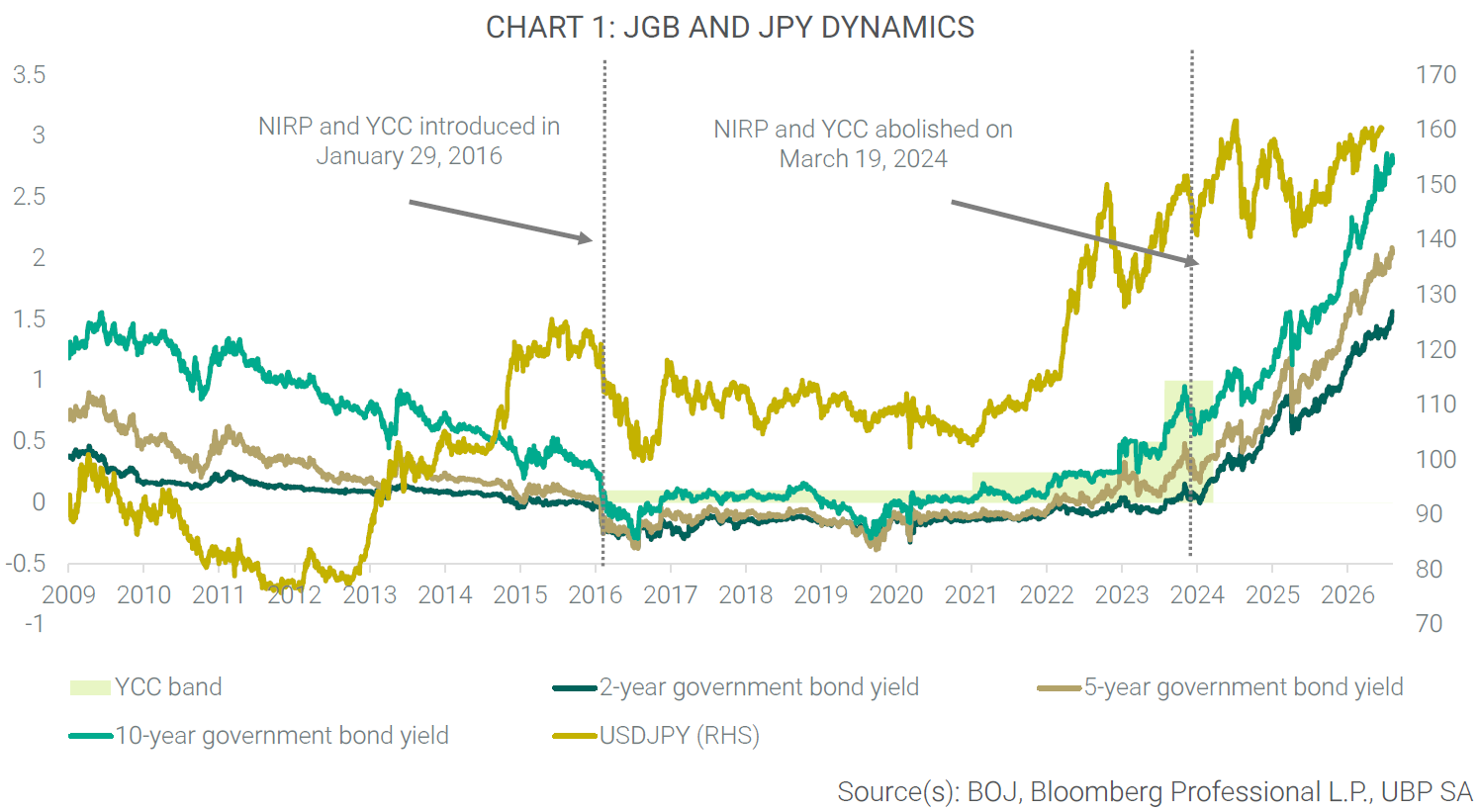
The most recent adjustment was in June 2026, when the BoJ raised its policy rate by 25 bps to 1.00%. The bank cited progress towards a sustainable wage–price cycle, firmer medium-term inflation expectations, and still-accommodative real rates. Deputy Governor Uchida stressed data dependence and declined to define a neutral rate, while real rates remain negative. Markets appear to favour a faster pace of adjustment than the BoJ is signalling. Current pricing implies roughly two increases in 2026, with the overnight index swap (OIS) market assigning an 81% probability to a September move, with a terminal rate of 1.75% to 2.00% by mid-2027. While we do not dispute the direction of travel, the market may be pricing in too much action.
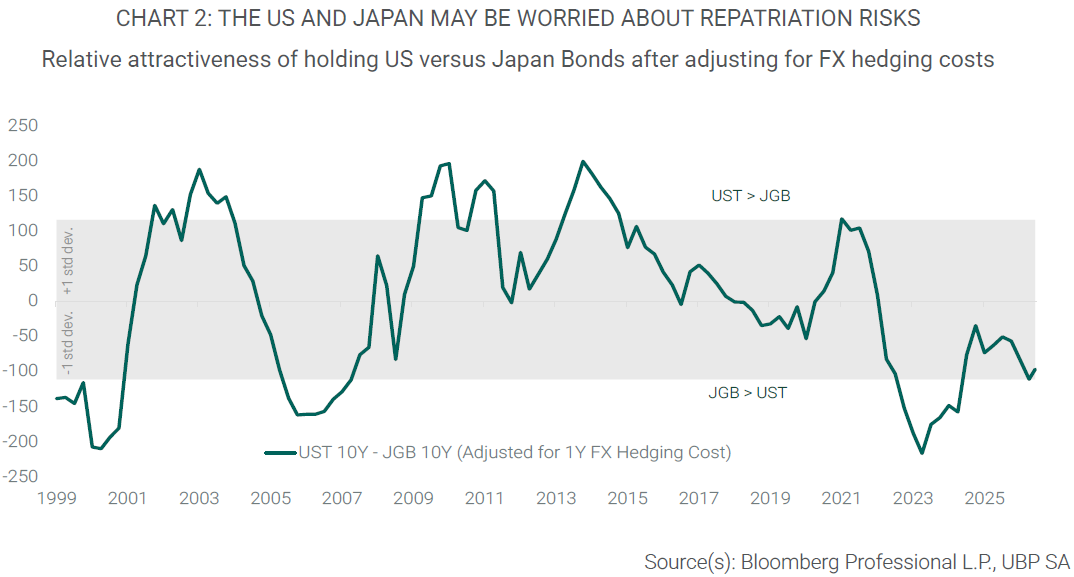
Rate differentials support the case for additional hikes. With the BoJ at 1.00% and the Fed at 3.75%, the 275-bp gap still favours the dollar (see Table 2). The differential has narrowed markedly since the BoJ started its hiking cycle in early 2024, but carry incentives persist. On a hedged basis, Japanese yields have become more competitive for domestic institutions, which can temper outbound flows and fuel repatriation risks (see Chart 2), a scenario that has led to increasing anxiety in Washington. However, nominal policy-rate gaps still dominate in FX spot trading, particularly given the yen’s role as a funding currency. If there is no further BoJ tightening or faster Fed cuts, the yen remains vulnerable to carry-driven selling and should continue to face depreciatory pressures.

Beyond rate differentials, fiscal concerns and heavier supply are exerting additional pressure on JGB yields, particularly at the long end. Prime Minister Sanae Takaichi’s flagship Technology Growth Strategy aims to mobilise more than JPY 370 trillion (around USD 2.5 trillion, or roughly 50% of 2025 GDP) in public and private investment through fiscal year 2040 across 17 advanced technology and industrial policy areas (page 10).
Together, these moves have intensified concerns about debt sustainability. As a result, bear steepening has been most pronounced in the super-long sector, where fiscal risk premia are most sensitive. These factors are keeping upward pressure on longer-dated yields.
Technical factors are also at play. Rising JGB yields have created balance-sheet pressures among the major buyers of the super-long segment. Traditional purchasers of super-long JGBs, notably life insurers and pension funds, are probably sitting on unrealised losses in their bond portfolios and have reduced purchases, contributing to bear-steepening (see Chart 3). The move in yields has mechanically reduced the mark-to-market value of legacy low-coupon holdings, with the largest impact on life insurers, whose domestic bond books are closely tied to long-duration liability matching.
Major insurers may have been trimming low-coupon legacy bonds and selectively rotating into higher-yielding securities. Insurer repositioning has therefore become an important upside catalyst for JGB yields, particularly at the super-long end of the curve. At the same time, new solvency and accounting considerations can reinforce selling pressure, as higher yields deepen unrealised losses and may encourage insurers to shorten duration or avoid impairment triggers. This creates a negative feedback loop in which rising yields lead to portfolio sales, which, in turn, place further upward pressure on yields.
The government is seeking to cultivate more domestic demand, including signalling a potential Government Pension Investment Fund (GPIF) reallocation that could provide billions of US dollars in additional capacity to increase JGB holdings. While the GPIF’s broader portfolio has absorbed domestic bond losses through strong equity performance, insurers face a more acute challenge.
The key market implication is that the traditional domestic anchor for super-long JGB demand has weakened. Life insurers are less able to act as a stabilising buyer than in previous cycles, adding cyclical upward pressure on rates. With the sector no longer reliably absorbing supply, offshore investors and more tactical buyers have become more important at the margin, leaving the long end more vulnerable to volatility, fiscal concerns, and further BoJ tightening expectations. Until life insurers re-emerge as sustained structural buyers, upside yield risk is likely to continue, supporting a steeper JGB curve and higher term premia.

Japan's debt sustainability is not yet a problem
Prime Minister Sanae Takaichi has adopted a ‘responsible and proactive’ fiscal stance that prioritises growth and strategic investment over near-term debt consolidation. A defining element of her plan includes dropping Japan’s long-held goal of achieving a primary balance surplus on an annual basis, shifting the anchor instead to a reduction in the debt-to-GDP (gross domestic product) ratio over the medium term; in other words, relying on faster nominal GDP growth to lower the debt burden over time.
The programme has three main prongs. First, in November 2025 the government approved the largest post-pan-demic supplementary package, allocating about JPY 17.7 trillion (roughly USD 120 billion, or around 3% of GDP) to cost-of-living relief with targeted support for AI, advanced semiconductors and economic resilience. Second, a longer-term road map envisages more than JPY 370 trillion (about USD 2.5 trillion, roughly 50% of 2025 GDP) in public and private investment across 17 strategic sectors through fiscal year 2040, targeting areas such as artificial intelligence (AI), semiconductors, and defence. Third, near-term inflation relief includes a June 2026 sup-plementary budget of JPY 3.1 trillion (about 0.5% of GDP) for subsidies on petrol, electricity and gas. Additionally, on 5 August, the cabinet approved a plan to reduce the food consumption tax from 8% to 1% for two years from next April. However, the proposal must still be passed by the National Diet, Japan’s legislature, before the con-sumption tax law can be amended.
Takaichi’s approach also interacts closely with monetary policy. She has signalled a preference for easier financial conditions, reportedly urging the BoJ to step up JGB purchases and appointing reflation-minded/dovish board members (including Toichiro Asada and Ayano Sato), while formally affirming the central bank’s independence. The key risk is that repeated stimulus and structurally higher defence spending push borrowing higher just as the BoJ normalises its policy.
Markets anticipate that the package, particularly the JPY 370 trillion long-term investment plan and the proposed temporary cut in the food sales tax, will require additional bond issuance. With gross government debt near the highest in the G7 (over 200% of GDP) and the budget deficit at around 3% of GDP, long JGB yields have risen, reflecting unease about heavier issuance. Even so, a crisis appears distant given the debt is denominated in JPY and largely held by domestic investors.
According to OECD figures, Japan’s gross debt servicing costs are about 1.3% of GDP, below those of the United States at roughly 4.7% of GDP, reflecting decades of low rates and the BoJ’s asset-purchase programmes. The BoJ holds a large stock of assets, including domestic and foreign bonds, equities, REITs, and foreign-exchange reserves. As a result, net debt is lower, at around 124% of GDP, and net debt-servicing costs remain managea-ble at roughly 1%. With 10-year JGBs now near 2.90% and rising, refinancing will progressively lift debt-servicing costs, which could eventually pose sustainability challenges.
Is the BOJ behind the curve?
Inflation has cooled, with both headline and core measures remaining slightly below the 2.0% target at 1.9% y/y in July. However, medium-term inflation expectations remain anchored. The 10-year breakeven reached 2.0%, while the latest Tankan survey places inflation at 2.7% in one year’s time (see Chart 4). This view is underpinned by the expectation that real wage gains will support stronger private consumption into 2027. The 2026 Shuntō spring wage negotiation delivered an average pay rise of 5.26%, the third consecutive year above 5.0%, while average real cash earnings rose by 2.2% y/y in June, marking a seventh successive month of positive growth.


Nevertheless, inflation continues to exceed the BoJ’s policy rate, resulting in negative real rates. Although the BoJ is not alone among major central banks, Japan’s nominal rates remain the lowest in the G10. A Phillips curve lens helps frame the extent to which rates should be higher. Unemployment has hovered below Japan’s NAIRU (non-accelerating inflation rate of unemployment) at around 2.5% since 2018, reflecting the structural features of Japan’s labour market rather than classic late-cycle overheating. For decades, Japan experienced sticky deflation despite low unemployment, which can be explained by age demographics and high debt sensitivity associated with elevated levels of government and household indebtedness. These factors contributed to the development of a flat Phillips curve (see Chart 5). In other words, inflation changes cannot be explained by labour-market tightness alone.
The 2022–23 inflation surge was largely imported via energy and food, including the impact of disruptions to domestic rice crop yields. From 2024, large Shuntō wage settlements shifted the narrative towards a more favourable domestic wage-price dynamic (the so-called ‘virtuous cycle’) and a potential steepening of the Phillips curve. It is also important to note that although headline and core inflation have softened, this partly reflects subsidies introduced under Sanae Takaichi, which may cloud the underlying trend.
However, the Phillips curve itself does not prescribe an interest-rate level. For this, the Taylor rule is more informative. The Taylor rule is a simple guideline that sets the policy rate based on the neutral rate plus adjustments for the deviation of inflation from the target and the size of the output (or unemployment) gap. A simple version is:
i=r*+ π+0.5(π-π*)+0.5(y-y*)
Where:
i = nominal policy rate
r* = neutral real rate
π = inflation
π* = inflation target, usually 2%
y-y* = output gap
Assuming a neutral real rate of about 0.25% (the BoJ’s own range is approximately -0.9% to 0.5%), using the BoJ’s latest output-gap estimate of 0.53%, and headline inflation at 1.9%, the implied nominal policy rate would be about 2.63%, which is well above the BoJ’s current policy rate of 1.00%. However, Japan is a special case. A more cautious neutral rate assumption, given the aforementioned structural factors, would be 0.0%. Moreover, inflation has so far been partly cost-push. If we use services inflation of 1.2% in July as a proxy for demand-pull inflation instead, then the implied policy rate falls to about 1.33%, which is still above BoJ’s current policy rate of 1.0%.
Applied mechanically in a US-style framework, the Taylor rule would suggest that Japan’s policy rate should be much higher. Arguments for a quicker pace of normalisation include tight labour markets, sustained wage gains, negative real rates, and yen-credibility concerns evidenced by repeated interventions. Balance-sheet pressures and weaker demand for super-long JGBs also argue for rebuilding policy space sooner. Conversely, cooling inflation, a relatively flat Phillips curve, and still-fragile domestic demand support a more measured approach. Abrupt tightening risks overshooting financial conditions and jeopardising a nascent consumption recovery supported by real wage gains. Calls by US officials for a more aggressive pace of normalisation are unlikely to be met with decisive action, as the BoJ’s ‘virtuous cycle’ has practical limits.
Risks to a cautiously hawkish outlook
If we view Japan’s policy dilemma through a monetarist lens, which holds that interest rates are largely incidental and that money growth is the key driver, we reach different conclusions (see Chart 6). While policymakers and investors focus on exogenous inflation shocks and rising bond yields, the real question is whether Japan can prompt cash-rich corporates to change behaviour and put idle balances to work. Historically, Japanese non-financial corporations have been net lenders and hold sizeable cash piles; this is estimated at about JPY 350 trillion (approximately USD 2.4 trillion), equivalent to roughly 57% of 2025 GDP according to OECD data.
The appropriate policy focus should be broad money rather than its symptoms. In other words, the authorities should consider ways to incentivise corporates to deploy their cash. However, this is not the focus of Prime Minister Takaichi’s policy agenda. Admittedly, higher inflation can help by increasing the long-run opportunity cost of holding cash. A global AI capex cycle is also constructive for some sectors. The risk, however, is that interest rates are raised too quickly without addressing the true driver of nominal GDP. Tightening the price of money while leaving the velocity of money unchanged or weakening could suppress nominal spending and stall Japan’s nascent consumption recovery. In this scenario, demand-pull inflation would fail to materialise and the BoJ would be left with lower rates for longer, waiting for a ‘virtuous cycle’ that may never occur.
Last, a slower pace of quantitative tightening (QT) could help stabilise the market into 2027. At its June Monetary Policy Meeting, the BoJ confirmed a gradual tapering of JGB purchases by roughly JPY 200 billion per quarter until Q1 2027, before stabilising monthly purchases at about JPY 2 trillion from April 2027. Demand from traditional stabilisers of long-term yields has weakened due to technical factors, and while Prime Minister Takaichi is seeking to bolster this via the GPIF, a more gradual pace of QT could help alleviate upward pressure on the long end of the yield curve by supporting steadier supply-demand dynamics.

Implications for investors
Our baseline is that the BoJ will continue with gradual, data-dependent normalisation. Markets may be getting ahead of themselves and pricing in too much action for 2026. Given current visibility, we expect only one or two further 25-bp adjustments, with terminal rates around 1.25% to 1.50%. Given recent currency pressures, the timing of the next adjustment could be brought forward to October 2026, although the September meeting remains ‘live’. This appears optimal given current visibility and after considering the fundamental and technical drivers of market volatility. Recent steps have restored credibility after a late start in 2022–2023, but the greater risk now lies in falling behind the currency curve rather than the inflation curve.
Foreign exchange (FX): The joint US-Japan intervention represents a significant escalation and should raise the near-term cost of speculative yen selling. It is, however, no substitute for fundamentals. The yen remains under pressure from a still-wide rate gap, negative real rates, and cautious BoJ pacing. For a more sustainable turn, either the BoJ would need to tighten more than expected, the US Federal Reserve would need to cut rates, global bond yields would need to decline, global energy prices would need to fall, Japan’s real wages would need to exceed expectations, or forced short covering would need to occur.
Rates: JGB yields should remain under upward pressure as normalisation progresses. Although the bias is towards higher yields, steadier supply demand dynamics following a slower pace of quantitative tightening by the BoJ and gradually improving demand from life insurers, together with potential GPIF related reforms, should help to cap yields within a 2.5% to 3.0% range for the remainder of 2026 and into H1 2027. Beyond this, the path will depend on whether the BoJ’s ‘virtuous cycle’ takes hold and whether the wage–price cycle proves sustainable. Hypothetically, this would imply higher terminal rates and higher JGB yields, but we do not yet have sufficient visibility to assess this with certainty.
Equities: Around 70% of Topix earnings are generated outside Japan, which helps explain the inverse correlation between yen depreciation and overall performance of Japanese equities. A firmer yen would weigh on exporters, while a currency around USD/JPY 155–163 should sustain the rally. Financials have benefited from higher domestic rates, and this should continue as the BoJ proceeds with a cautious pace of policy normalisation. The overall impact hinges on whether markets interpret BoJ tightening as gradually improving nominal growth or as a pro-cyclical headwind. Our baseline scenario assumes a gradual pace of policy normalisation which favours the former.
The opinions expressed herein are correct as at 28 August 2026 and are subject to change without notice. This information should not be relied upon by the reader as research or investment advice regarding any particular fund, strategy or security. Past performance is not a guide to current or future results. Any forecast, projection or target, where provided, is indicative only and is not guaranteed in any way.