The outbreak of a new Middle East conflict involving the US, Israel, and Iran rattled financial markets last week, triggering a broad risk-off shift.
Equity markets retreated, with losses concentrated outside the US. Interest rates spiked, while gold fell unexpectedly and the USD edged higher, reflecting rising risk aversion. How oil prices evolve in the coming days will remain a key focus for investors.
Market recap

Beyond the numbers
Macroeconomics
This week, buoyant business sentiment met a volatile geopolitical backdrop. In the US, despite weather-related drag, services activity surged: the Institute for Supply Management (ISM) services index hit 56.1, its highest since 2022, driven by all sub-components, underscoring the economy’s resilience. Manufacturing held most of last month’s big gain, with the ISM at 52.4 (vs 52.6 prior), while the final Purchasing Managers’ Index remains near cycle highs (51.6). Nevertheless, manufacturers reported a sharp rise in input costs, even before the attacks on Iran. If the recent increase in energy prices persists, firms may have little choice but to pass costs on, potentially increasing inflation.
The February jobs report cast a shadow over January’s upbeat mood. Total payrolls fell by 92,000, with private payrolls down 86,000, a cycle low, dragged by a 19,000 decline in healthcare employment. One-offs likely amplified the weakness: severe weather, a strike at Kaiser Permanente (healthcare sector), and revisions to the BLS “birth–death” model. Stripping these out, the labour market still looks to be softening rather than slumping. Bad weather also contributed to tepid retail sales, which dipped 0.2% m/m.
Across the eurozone, inflation re-accelerated more than expected in February: the headline flash Consumer Prices Index (CPI) rose from 1.9% to 2.1%, while core ticked up from 2.2% to 2.4%, helped by a jump in Italy’s Olympics-related services, adding to fears that consumer prices could prove stickier in light of surging energy prices. Final services PMI sentiment was better than expected (51.9) as Germany and France progressed while Italy and Spain eroded. Final manufacturing sentiment (50.8) confirmed a nascent recovery in manufacturing, though persistently high energy costs could derail it.
Looking ahead, America’s small business sentiment will be in focus, particularly price-setting intentions, alongside February inflation and consumer sentiment. In the eurozone, final CPI data and industrial production from Germany and Italy will offer fresh read-throughs on the manufacturing rebound. Nevertheless, investors will closely watch the evolution of oil prices, as they could jeopardise the consensus view of resilient growth and disinflation progress.
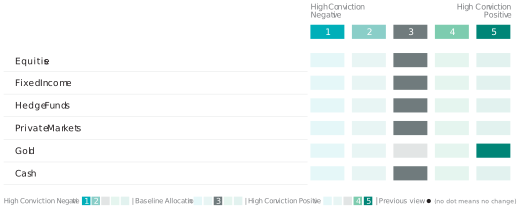
Asset allocation: strategic views as at March 2026
Update: US / Iran
Investment strategy & asset allocation
The recent escalation around Iran has evolved from a geopolitical risk into a potential macroeconomic shock. The transmission channel through higher energy prices and slower trade has started as shipping through the Strait of Hormuz has slowed to a near-halt. If sustained, this will start testing the world economy’s resilience as the main risk is slower growth alongside higher inflation, also known as stagflation. Europe and much of Asia have demonstrated stronger sensitivity to the conflict and the disruption of global energy flows due to their status as net importers of energy, in contrast to the US, which is a net exporter and the largest oil producer globally.
For global equities, the principal risk is a sustained period of severe oil disruption that weighs on economic growth and undermines corporate confidence and the nascent rebound in industrial activity that has contributed to recent rallies in many “old economy” cyclicals and regions. This would result in current earnings growth expectations (MSCI ACWI +17%) to move lower accompanied by a possible valuation contraction (current forward PE at 18.1x vs 10yr average 17.2x). The US, in this respect, remains better protected from earnings revision downgrades due to its heavy exposure to the technology sector and Mag7 (combined representing ~54% of 2026 US earnings per share growth) which remain relatively immune to the conflict. Conversely, Europe’s limited exposure to the technology sector (7% of STOXX Europe 600) will not be sufficient to compensate for macro weakness in other areas (Financials 23.8% of index, Industrials 19.2%).
For fixed income, the main risk is persistently higher energy prices, which would feed directly into higher inflation expectations. Here, government bonds would fail to act as the typical safe haven, with yields on government bonds moving higher (as they have over the past week). While we have not seen significant spread widening so far, an energy shock would surely send spreads higher. For the moment, we have reduced exposure to AT1 bonds (early last week), as these were trading at very tight levels. We are not changing our strategic view of being positive on high yield and emerging markets, while having duration above neutral - but stand ready to reassess this view if the Strait of Hormuz doesn’t reopen soon..
Conclusion
With visibility remaining low, we deem it too early to change our strategic views and economic growth assumptions for 2026 at this stage. We have made no further changes to portfolios following last week’s performance and remain vigilant to evolving newsflow in order to act swiftly and capture investment opportunities as they may arise.
Equities
Global equities fell last week (MSCI ACWI total return -3.7%) as the onset of a new conflict in the Middle East (US–Israel–Iran) and the resulting impact on oil prices, inflation expectations, and long-term interest rates led to a heightened risk-off mood. Negative sentiment was further amplified at week’s end following weak US labour data. All global sectors moved lower, except energy (+1.3%), with materials falling the most (-8.7%) as investors locked in profits after strong year-to-date gains (+20.6% through 27 February).
Notably, ex-US indices sustained far larger weekly declines than their US counterparts. While the S&P 500 fell -2.0% and the Nasdaq -1.2%, Europe (STOXX Europe 600) declined -5.5%, Japan (Nikkei 225) -5.5%, and emerging markets (MSCI Emerging Markets) -6.9%.
US outperformance was led by relative strength in technology and the “Magnificent 7” (-0.4% and -0.6%, respectively), reflecting their perceived insulation from the conflict alongside some year-to-date underperformance, while price action in European and Asian indices underscored their structural vulnerability to energy dependence and some profit-taking.
Equity market moves will continue to be driven by geopolitical developments in the week ahead. At this stage, the US–Israel–Iran conflict and the near closure of the Strait of Hormuz continue to instigate near-term volatility. A de-escalation in tensions will be necessary for equity markets to regain their footing and investor confidence.
Technology held up better, driving the US market’s relative outperformance versus non-US markets
Fixed income
The US–Israel military campaign in Iran drove a counterintuitive sell-off in government bonds, as inflation fears from surging energy prices overwhelmed the demand that had been pushing yields lower just days before the conflict broke out. By the end of the week, yields had risen back to the middle-to-upper end of their multi-month ranges. The US 10-year moved up 20 basis points (bps), the Bund 22 bps - the largest weekly move since Germany announced its fiscal spending package in March last year - and the UK gilt bore the brunt with a 39-bps swing, the largest since the September 2022 mini-budget crisis. This upward move continued into Monday morning. Derivatives markets now price in two rate hikes by the European Central Bank (ECB) this year, a complete reversal from a week earlier when a 50% probability of a cut was priced. Similarly, expectations for two Bank of England (BoE) cuts by year-end have shifted to a 70% probability of one hike.
The bond market’s failure to sustain a rally underscored a key dynamic: when geopolitical risk feeds directly into inflation via energy prices, the traditional flight-to-quality playbook breaks down. The primary transmission channel was inflation expectations rather than “safe-haven flows”, meaning price action will remain heavily driven by developments in the conflict. Any ceasefire signals or further escalation will trump other factors.
Somewhat surprisingly, given the magnitude of the moves in rates and equities, credit spreads were relatively calm, finishing the week virtually unchanged and only slightly wider since the end of January, with 10 bps for Investment Grade (IG) and 35 bps for High Yield (HY). Even Gulf Cooperation Council (GCC) sovereign spreads moved up only marginally. For the week, Treasuries and IG were down 0.6%, HY lost 0.4%, and AT1s returned -0.9%, with Emerging Markets (EM) -1.2%.
Our central scenario is one where the Strait of Hormuz, through which approximately 20% of global oil transits, is reopened to marine traffic soon and a broader energy crisis is avoided. Under such a scenario, rates are expected to move back down. For this reason, our duration stance remains unchanged.
Yields have risen back on the back of inflation fears from surging energy prices
Forex & Commodities
Last week, the USD edged higher against most G10 and emerging market (EM) currencies, reflecting rising risk aversion and the events in the Middle East. The effects are entirely consistent with what we typically see following conflicts and rising oil prices. US data were mixed, and labour market data printed at weak levels (NFP data). In the absence of the conflict in the Middle East, the USD would likely have weakened given the labour market data. The main event over the coming week will be the release of CPI data for February, and recent prints have surprised to the downside of expectations. The USD should remain at firm levels until markets receive clarity on the conflict in the Middle East.
NOK exchange rates performed well, with EUR/NOK falling to around 11.15. The price action is consistent with previous episodes of sudden rises in the oil price, and it is no doubt helped by having the highest front-end carry in G10. Markets are moving to price in Norges Bank rate hikes (not cuts as before), giving NOK added momentum. The publication of CPI data for February is the main event over the coming week.
CNY weakened modestly last week, reflecting the rise in front-end yield spreads. Beijing’s latest policy announcements are unlikely to have a big impact on CNY in the short term; however, our USD/CNY forecast was lowered given CNY’s extremely strong start to the year, and the shift in the official Chinese narrative towards CNY becoming an ‘asset-based’ currency.
Gold traded lower last week to around USD 5,050 per oz, and subsequently rallied to around USD 5,150 per oz following the publication of US CPI data. Gold’s price action was counterintuitive, and likely reflects standard behavioural finance in action, with investors selling performing assets to fund underperforming positions. If equity markets stabilise, it is likely to support gold prices, and underlying economic data (US NFP, etc.) are conducive to gold trading at higher levels over the medium term.
The USD is likely to remain firm until markets gain clarity on the conflict in the Middle East
Energy
Energy markets have shifted from concerns about excess supply to concerns about availability amid disruptions around the Strait of Hormuz. It remains effectively closed, trapping around 20% of global oil and liquefied natural gas (LNG) flows. Oil prices spiked above USD 100 per barrel on Monday as risk premia and uncertainty increased.
Most producers in the Middle East have initiated precautionary production and refining cuts across the region due to storage constraints, with estimates suggesting roughly 3 million barrels per day are temporarily offline. In response, trade flows are adjusting: Asian buyers are turning to US crude; Russian oil stored at sea has entered the market under temporary licences; and pipeline rerouting in Saudi Arabia and the UAE is marginally helping bypass Hormuz. A G7 virtual meeting is reported to be taking place on Monday to discuss a coordinated release of strategic reserves.
From a risk perspective, the key escalations to watch are strikes on oil infrastructure and the duration of the closure of Hormuz, which together represent a direct supply-shock risk.
As of today, our strategic view remains unchanged. We continue to see the current move primarily as a logistical disruption rather than a structural shift in oil fundamentals, as the oil market is not yet facing a physical shortage. Our base case remains a “Contained Tension” scenario, in which Brent prices spike temporarily before retracing towards roughly USD 70 per barrel by year-end. Our rating of 3 out of 5 on the energy sector serves as a hedge against escalation risks and to reflect tighter supply–demand balances.
Our stance on the energy sector acts as a hedge against escalation risks
The opinions expressed herein are correct as at 9 March 2026 and are subject to change without notice. This information should not be relied upon by the reader as research or investment advice regarding any particular fund, strategy or security. Past performance is not a guide to current or future results. Any forecast, projection or target, where provided, is indicative only and is not guaranteed in any way.