2026 will not reward broad exposure to private markets, rather the deliberate exposure to the right strategies, structures and managers.
Key Takeaways
1. Private markets have entered a post-complacency phase
The era of abundant liquidity and indiscriminate capital deployment is over. Dispersion across managers has widened materially, making selectivity and governance the primary drivers of long-term returns.
2. Infrastructure is now a core allocation
The infrastructure transition combines structural growth, regulatory support and defensive cash-flow profiles, positioning it as a key stabiliser and long- term value driver for portfolios.
3. Financial engineering is increasingly central to market functioning
Tools such as significant risk transfers and continuation vehicles are now structural components of private markets, supporting liquidity and capital efficiency while at the same time bringing a form of tail risk.
4. Private credit is evolving from yield-driven momentum to underwriting-driven idiosyncracies
Late-cycle conditions favour strategies with strong collateral, cash-flow visibility, amortisation and conservative structures. Performances will increasingly depend on manager quality and strategy selection rather than market momentum.
5. Banks and private credit are deeply interconnected
The credit cycle is now shaped by feedback loops between banks and private funds through leverage, warehousing and risk-transfer mechanisms, reinforcing the need for holistic risk assessment while visibility is challenged.
6. Private wealth flows remain structurally supportive, but are not risk- free
Private wealth vehicles are expanding access to private markets, but their liquidity mechanics remain largely untested in stress scenarios, warranting contained optimism.
Complacency is over
Time of momentum-driven allocations appears to be behind. Value creation, idiosyncratic risk and rigorous allocation will be the rewarded factors.
2025 is wrapping up and, as in previous years, the initial plan deviated. Geopolitics were complex, with ‘Liberation Day’ and the ‘Big Beautiful Bill’ in the US reshaping trade dynamics, while Trump 2.0 proved more volatile and less predictable than Trump 1.0. Markets experienced significant bouts of volatility but ended on a strong note at time of writing, thanks to resilient consumer data, an improving inflation trajectory and a decisive pivot in global monetary policy expectations.
In this environment, private markets broadly delivered what was expected, yet the sense is growing that the ‘golden age’ is now behind us. The asset class entered a phase where discipline replaced exuberance: allocation discipline tightened, underwriting standards normalised, and dispersion across managers widened materially, as illustrated in the business development company (BDC) segment where credit losses, pricing differentials and liquidity considerations exposed inconsistent underwriting quality. Capital formation slowed meaningfully, and the valuation reset continued to separate durable franchises – i.e. those anchored in operating strength, governance depth and balanced capital structures – from models relying too heavily on financial engineering.
This is not a crisis; it is a transition. Private markets are by no means broken, they are maturing. The industry is moving from a decade of cheap liquidity and relentless growth to an environment where capital is somehow scarcer, information asymmetry is narrowing, and investors are demanding more transparency on risk and liquidity. Selectivity, liquidity awareness and a clear understanding of the risk premia harvested emerged as the defining themes of 2025; they will strengthen further in 2026 as allocators rotate towards managers with genuine sourcing advantages, resilient balance sheets and the ability to generate returns through operational value creation rather than leverage alone.
The next cycle will reward clarity, discipline and governance. The time for complacency is behind us; private markets are entering a phase in which judgment, not momentum, will define outcomes.
The return of financial engineering
Liquidity is scarce. Distributions are slow. Valuations are sticky. Engineering is back at the centre of private markets, but is it for the greater good?
Financial engineering never disappeared, but in 2025 it became a more prominent tool used within private markets to deal with liquidity, risk dissemination, and asset rotation. Significant risk transfers (SRT), continuation vehicles, and the rise of limited partner (LP)/general partner (GP)-led secondaries are now an integral part of managers’ operational reality. Going into 2026, it is anticipated that financial engineering will take up an even greater part of activity, posing the question: what are the implications for the industry and market structure?
Significant risk transfers: support for credit flows yet opaque
Significant risk transfer (SRT) transactions are one of the fastest-growing areas of the financial markets, offering private credit investors direct access to diversified credit risk pools. The rapid growth of this market contrasts sharply with the more muted activity in the traditional securitisation market.
Essentially, SRT deals transfer credit risk on a reference pool of bank assets to private investors and are used by banks for regulatory capital optimisation. As banks are optimising their balance sheets to continue to originate deals, SRTs are an essential tool for maintaining issuance momentum while carefully managing risk-weighted assets (RWAs). Initially, SRTs were focused on corporate loans, but the market has expanded to broader and more exotic assets, such as net asset value (NAV) loans, subscription credit lines, and AI debt, as recently illustrated by the potential Morgan Stanley deal.
Private credit investors have become more interested in SRT deals as a means to deploy capital quickly. SRTs provide compensation through a coupon paid by the protection buyer (the bank). Because they usually reference high-grade corporate or institutional bank portfolios, they are considered high-quality private investments within the growing universe of asset-backed finance. The reduction in RWAs achieved by a bank directly improves their regulatory capital ratios, establishing SRTs as a non-cyclical, regulation- driven flow of attractive private credit assets.
However, SRTs also introduce opaque concentrations of tail risk: investors rely heavily on banks’ internal models and underwriting standards, which are not always fully transparent or independently validated. In a severe downturn, correlation across reference pools could rise sharply, causing losses to become more simultaneous than historical data would suggest.
SRT ISSUANCE BREAKDOWN BY REGION

GP-led secondaries: inside the ecosystem of continuation vehicles
Investors are starting to feel the pain of a generalised slowdown in exits. Although the reasons behind this have been widely discussed, it is nonetheless a major hurdle for investors and managers alike. This lack of exit liquidity has amplified the use of general-partner (GP)-led secondary transactions, especially so-called continuation vehicles (CVs). These transactions allow a sponsor to move high-conviction assets from an existing vehicle into a new one, enabling continued management control while providing necessary liquidity options for existing and exiting investors. This adaptability has been essential given the difficult environment for raising capital and illiquid markets.
However, the rapid growth and structural nature of CVs have attracted heightened regulatory and investor scrutiny, with some investors fighting against some proposals. For its part, the regulators have been vocal about the lack of disclosure of potential conflicts of interest.
The long-term health and scaling of the CV market is thus contingent on managers demonstrating solid governance and transactional transparency. Although it is now widely recognised and accepted that CVs are necessary tools for solving liquidity pressure, they introduce complexity to valuations and fiduciary responsibilities. Investors entering this market in 2026 must demand rigorous due diligence on the GP’s internal governance processes in order to mitigate the risks associated with these potentially conflicted transactions.
ANNUAL CAPITAL CALLED UP AND DISTRIBUTED

GP-LED TRANSACTIONS VOLUME BY SECTOR, H1 2025
Private markets and private wealth: the love story continues
The democratisation of private markets seems unstoppable. From private wealth funds to insurance and pension funds, the investment universe is evolving rapidly and has long-lasting consequences.
Private markets and private wealth are entering a new phase of structural convergence and growth. What began as a targeted expansion into the private wealth segment has now accelerated into a broad, global demand that is significantly reshaping industry economics. In 2025, another inflection point emerged: the credible perspective of the inclusion of private markets into defined-contribution plans, which would unlock one of the largest untapped capital pools in the world.
For asset managers, these changes are more transformative across the board: wealth channels are now the fastest-growing source of recurring fees, while the retail ecosystem is now looking beyond private credit and is keen to expand into other areas. At the same time, regulatory momentum in the US suggests that retirement savings vehicles may soon become a scalable, long-duration source of capital for alternatives. According to Goldman Sachs, the ‘semi-liquid’ NAV stood at USD 426 billion in Q3 2025, following a 40% compound annual growth rate (CAGR) since 2021.
Private wealth vehicles that package illiquid assets and strategies into interval funds or semi-liquid funds are also becoming an integral part of the asset allocation toolkit. But it must be remembered that these vehicles have not yet been tested in a coordinated stress scenario, and caution about their use must remain the base case rather than that of the general excitement.
Together, these developments signal a durable realignment: private markets are becoming an integral part of household balance sheets, not just institutional portfolios. The implications for product design, liquidity management, and capital formation will define the next decade of investments in the industry.
Supportive flows from private wealth
Private wealth remains a solid structural growth driver for alternative asset managers, securing its position as the fastest-growing source of revenue for the industry. According to Goldman Sachs, as at September 2025, the total net asset value of wealth-focused vehicles had reached approximately USD 430 billion, reflecting robust organic growth.
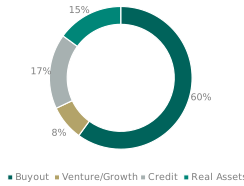
While private credit (mostly direct lending) currently dominates the landscape and accounts for approximately 50% of the private wealth retail NAV based on Goldman Sachs’ data, the market is actively diversifying. The noise experienced in private credit in H2 2025 generated some concerns about credit quality, although BDC data (the bellwether of private credit) continues to point towards idiosyncratic issues rather than systemic flaws.
The key strategic trend in private wealth is the rapid expansion out of private credit into private equity and infrastructure. These asset classes collectively represent a NAV of roughly USD 125 billion, increasing 80% year-on-year. Gross inflows across these diversified products show strong momentum, printing a 60–70% annualised growth rate in Q3. The new product pipeline is shifting away from pure direct-lending vehicles towards broader private markets, and away from funds focusing on secondary transactions to core and transition infrastructure. In the private wealth segment, real estate continues to lag behind in terms of development, as some funds activated gates in 2022 and suffered significant NAV impairment.
NET NEW ASSET RATE (TRAILING TWELVE MONTHS)

While the proliferation of new investment vehicles has broadened access to private markets, it is also introducing structural friction into how the asset class functions. Open-ended and semi-liquid fund structures impose a requirement for continuous capital deployment, a constraint that sits uneasily with the inherently lumpy, cyclical and opportunity-driven nature of private market deal flows. To manage this mismatch, private wealth vehicles are increasingly relying on secondary transactions as a deployment and liquidity management tool. This has created a self-reinforcing dynamic: structurally higher demand for secondaries has compressed discounts, eroding the liquidity and complexity premia that have historically underpinned the strategy’s appeal. In effect, a tool designed to mitigate structural constraints is now reshaping the economics of the secondary market itself.
NAV OF LARGETS PRIVATE WEALTH VEHICLES (USD BILLION)

Retirement plans about to enter the game
The idea of opening corporate defined-contribution (DC) plans, or 401(k)s, to private markets gained new momentum following an executive order signed by President Donald Trump in early August 2025. This order tasked the Department of Labor (DoL) and the Securities and Exchange Commission (SEC) with detailing how illiquid assets such as private equity, real estate, infrastructure, and digital assets could be incorporated into these retirement portfolios. The DC market is massive, representing over 90 million participants and an estimated value of USD 12 trillion, making it a significant potential market for private asset managers.
The 2025 order seeks to provide both regulatory clarity and legal protection by directing the DoL to re-examine its guidance under the Employee Retirement Income Security Act (ERISA) and shape ‘safe harbor provisions’. These provisions are vital, as extended litigation, such as the Intel v. Sulyma case, has intensified plan sponsors’ reluctance to add complex, illiquid assets without clear guidance.
However, the path to execution is challenging, with success not yet guaranteed due to remaining fee pressures, liquidity constraints, and governance hurdles. Private asset managers are looking at target-date funds (TDFs), which capture most inflows and represent about 40% of 401(k) assets, as the obvious entry point.
However, TDFs are highly cost-competitive, and adding private assets would inevitably raise fees, posing a commercial risk. Furthermore, managing illiquid assets requires complex technical solutions for daily liquidity, like redemption windows. Although Trump’s executive order set a 180-day deadline for regulatory guidance, mid-2026 or early 2027 appears to be a more realistic timeline for meaningful flows to begin. Initial allocations in adopting plans are expected to be modest, and are conservatively capped at 5–6%.
BREAKDOWN OF US RETIREMENT ASSETS

The financial instruments and investment strategies portrayed in this document are for informative purposes only. They may differ from those effectively held in an investor’ portfolio. Depending on the jurisdiction and investment profile, one or some of these instruments and strategies – including, where applicable, options – may not be permitted, available or suitable. The opinions expressed herein are correct as at 23 January 2026 and are subject to change without notice. Any forecast, projection or target, where provided, is indicative only and is not guaranteed in any way.
Reference to companies and/or investments is made for illustrative and informative purposes only. Such references should not be understood as an investment recommendation to buy, sell or hold any such company or investment, and cannot be considered to constitute personalised investment advice.