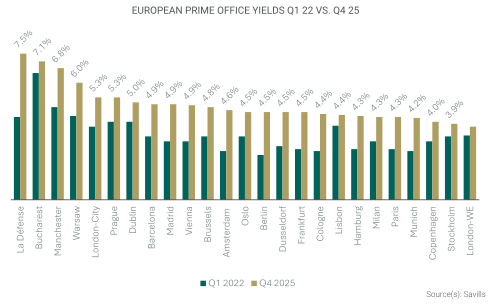
Since 2022 and the end of the ultra-low interest rate environment in Europe, the real estate sector has undergone a significant repricing. Yields have risen sharply, while transaction volumes and asset values have declined.
Executive summary
- A new real estate cycle: from yield compression to income growth
Higher interest rates, inflationary pressures and geopolitical uncertainty have led to a significant repricing of real estate, with higher yields, lower transaction volumes and declining asset values. - The limits of traditional core real estate
Traditional core real estate offers limited potential for capital appreciation, as elevated long-term interest rates reduce the likelihood of a sustained recovery driven by yield compression. - Operational real estate: capturing value beyond rent
Operational real estate allows investors to capture value beyond traditional rent by linking property income to the performance of the underlying business and benefiting from pricing, occupancy, services and operational efficiencies. - Target sectors: structural demand and operational upside
The operational real estate model is particularly relevant to sectors supported by strong long-term demand and offering meaningful opportunities for active management and additional revenue generation. - Managing complexity: key risks and mitigation strategies
Although operational real estate can offer higher potential returns, it requires strong expertise, high service standards, effective operating partners and careful management of operating risk. - Investing in structural growth
Disciplined underwriting and attractive entry prices can enable investors to create value from distressed, complex or underperforming assets through capital expenditure, repositioning, conversion and operational improvement.
A new real estate cycle: from yield compression to income growth
Since 2022 and the end of the ultra-low interest rate environment in Europe, the real estate sector has undergone a significant repricing. Yields have risen sharply, while transaction volumes and asset values have declined.
High levels of government debt and persistent deficits across Europe and the US have kept long-term bond yields high, despite the monetary easing initiated by central banks. More recently, renewed inflationary pressures and heightened geopolitical uncertainty (particularly in the Middle East) have reduced visibility and even triggered key interest rates hikes. This environment is likely to continue weighing on real estate valuations over the medium term.


1. European Central Bank
2. US Federal Reserve
The limits of traditional core real estate
Against this backdrop, traditional core real estate remains a particularly challenging asset class, offering limited potential for capital appreciation over the short-to-medium term. With real estate yields generally correlated with long-term bond yields, sustained valuation recovery through yield compression appears unlikely to occur.
At the same time, structural shifts: including hybrid working, the rapid development of artificial intelligence (AI), the continued growth of e-commerce and increasingly stringent ESG¹ requirements, are reshaping the office, retail and logistics sectors. Their transformation has accelerated the diversification of investment strategies into alternative real estate sub-sectors; increasing therefore substantially their liquidity.

In this challenging market environment, operational real estate focusing on alternative property types appears as a more favorable investment strategy.
1. Environmental, social and governance
Operational real estate: capturing value beyond rent
Operational real estate is emerging as an increasingly compelling investment strategy. Its defining feature is the alignment of property-level income with the operational performance of the underlying business.
Rather than relying exclusively on fixed rental income through rents, property owners participate directly in the asset’s economic performance. Depending on the structure, the investor may own or control both the real estate and the operating company, or partner with a specialist operator. This enables the investor to capture a greater share of the value generated by the asset.
By moving beyond the traditional landlord–tenant model, investors can access additional revenue streams linked to occupancy, pricing, ancillary services and operational efficiencies.
When successfully implemented, this approach can offer:
- Higher potential returns;
- Greater protection against inflation;
- Increased portfolio diversification; and
- Direct exposure to the economic activity generated by the asset.
For investors with the appropriate expertise, resources and operating partners, this can result in a more attractive risk-adjusted return profile.
Target sectors: structural demand and operational upside
In theory, the operational model can be applied across a wide range of real estate sectors. In practice, it is particularly relevant to asset classes supported by strong long-term demand fundamentals and offering meaningful potential to generate additional revenue through services and active management such as:
1. Luxury hospitality
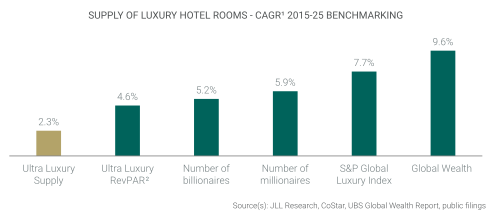
Luxury hospitality provides one of the clearest illustrations of the operational real estate model. Dynamic pricing, active revenue management and direct control over the profit and loss allow owners to benefit fully from a supportive market environment and capture the upside generated by strong operating performances.
2. High-end US multifamily residential
We also see attractive opportunities in the luxury US multifamily residential sector (residential asset divided in multiple units under the same ownership). These opportunities are particularly compelling in dynamic Tier 1 markets that are structurally undersupplied. In addition to benefiting from rental growth, these assets can generate incremental revenue through well managed services and amenities.
1. CAGR: compound annual growth rate
2. RevPAR: Revenue Per Available Room
Managing complexity: key risks and mitigation strategies
This approach does, however, introduce additional complexity and risk.
First, service quality and customer experience become central to financial performance. Successful execution requires a broad range of capabilities across operations, marketing, technology, revenue management and human resources. Selecting the right local operating partner is therefore critical.
Second, higher potential returns necessarily come with greater operating risk. Without the protection of a long fixed lease, operational underperformance or a market downturn can rapidly affect profitability and asset value.
Investing in structural growth
These risks can nevertheless be mitigated through disciplined underwriting and an attractive entry price. Current market conditions are creating distressed and appealing opportunities for investors able to move quickly, execute significant capital expenditure programmes or reposition/convert underperforming assets.
Combining value-added opportunities in sectors supported by structural demand though the operational angle can create a particularly compelling investment proposition in today’s market.
Download our latest UBP Headlines
The opinions expressed herein are correct as at 30 September 2026 and are subject to change without notice. This information should not be relied upon by the reader as research or investment advice regarding any particular fund, strategy or security. Past performance is not a guide to current or future results. Any forecast, projection or target, where provided, is indicative only and is not guaranteed in any way.