The AI boom has pushed the world’s five hyperscalers (Microsoft, Amazon, Alphabet, Meta and Oracle) into a new era of financing. In 2026, their capital spending is expected to exceed operating cash flow, with investment projected to reach USD 5.6 trillion by 2030, raising fundamental questions about how this unprecedented expansion will be funded.
Executive summary
1. Unprecedented AI Financing
Hyperscaler capex is expected to hit ~USD 820 billion in 2026 and USD 1.0 – 1.3 trillion in 2027, far outstripping the earnings power of the five hyperscalers (Microsoft, Amazon, Alphabet, Meta and Oracle). The gap is being plugged not just by bonds but across capacity – funded their project finance, securitisation, chip-backed loans, and equity.
2. Balance sheets are strong, but market appetite is the binding constraint
Microsoft, Alphabet, Amazon and Meta have ample leverage headroom and could add USD 400 – 600 billion more debt before there is any pressure on their ratings. The real limit is investor demand – spreads have widened, new-issue concessions have risen, and AA-rated tech bonds offer yields akin to single-A to BBB bonds.
3. Risk is concentrated in the order book, not the borrowers
The four largest cloud providers carry USD 2.3 trillion of contracted future revenue (backlog), with roughly 40% owed by two private, thinly disclosed companies – OpenAI and Anthropic. Anthropic is the stronger of the two (just turned profitable, USD 65 billion annualised revenue), while OpenAI is expected to burn over USD 200 billion in cash through 2029.
4. The bear case centres on timing and circularity
Lease and contract payments start on a schedule (centered around 2027–28), regardless of whether AI-Lab revenue has caught up. Much of the ecosystem is circular – suppliers are also investors and guarantors of the same customers – which could mask true demand, and a slowdown in growth rates (even without an outright decline) could strain the most leveraged marginal projects.
The short version
Until this year, the five hyperscalers – Microsoft, Amazon, Alphabet, Meta and Oracle, the companies that own most of the world’s computing capacity – funded their data centres from earnings. But in 2026 that stopped being enough; their capital spending this year is estimated to be USD 820 billion, well above the USD 750 billion of operating cash flow. Next year they are forecast to spend in the USD 1.0–1.3 trillion range. The scale is unprecedented. What the five now spend in a year is approaching the annual output of Switzerland, and on our own estimates their spending between now and 2030 adds up to USD 6.5 trillion.
This shortfall is being financed everywhere at once. The bond market has taken the largest share (USD 212 billion of debt in the first half against USD 115 billion of announced equity issuance), but it was never going to be enough on its own. The rest comes from private credit, project finance, securitisations, the leveraged loan market and, lately, structures that own the chips themselves. Behind all of it sits close to USD 3 trillion in obligations that do not appear on balance sheets at all. A programme this size is beyond the reach of any single market, so every market is carrying a piece of it.

The borrowers are some of the strongest in the market. Microsoft holds one of only a handful of corporate AAA ratings left in the world, and with three of the other four rated AA− or better, the group holds several hundred billion dollars of cash and, on top of this, earnings are expected to continue growing at a healthy clip and its customers are eagerly waiting for the computing capacity they cannot yet supply. The four highest-rated should add another USD 400 billion of debt over the next eighteen months without troubling their ratings, and an estimated USD 600 billion before a downgrade to single-A is envisioned.
The market’s willingness to absorb this is the tighter constraint. Six names, i.e. the five plus Nvidia, account for 4.6% of the US investment grade (IG) index. Widen the definition to everything the market now calls artificial intelligence (AI) and the figure is about 8.0%. Investors have responded by charging more, with spreads wider through the year and new-issue premiums rising. On our count as at 3 September, just over half of the bonds issued this year by Oracle, Meta, Amazon and Alphabet are trading at least 5 basis points (bps) wider than when they were issued at a time when the IG market as a whole is close to its tightest spreads since the financial crisis. July was the low point and much of the ground has since been made back, but the market has not stopped charging for the next deal.
The risk concentrates not in the hyperscalers’ balance sheets but in their order books. The four largest cloud providers (this excludes Meta) carried USD 2.3 trillion of contracted future revenue on their latest filings, up from USD 2.1 trillion three months earlier. A large share of it is owed by two private companies with little disclosure (OpenAI and Anthropic) and much of it relates to as-yet unbuilt capacity. Of the two, Anthropic is the cleaner name, as it reported an operating profit two years earlier than expected on annualised revenue of USD 65 billion, catering mostly to business clients. Against this, OpenAI is expected to burn more than USD 200 billion in cash through 2029.
We have come to three conclusions. The hyperscalers can finance what they have committed to and the ratings should hold at anything like current plans. The bond market will keep absorbing the supply, but at a price that has already moved and will move again with each jumbo deal, and the migration of issuance into other currencies and into project and chip structures is how that constraint makes itself felt. Whether 2027 is an uncomfortable or merely busy year depends on whether the two AI labs can pay when their contracts start billing, which is why the labs’ IPO Prospectus, the next big order book, and the first Microsoft bond in almost a decade are the things we are watching. Chapter 6 sets out the counterargument, which we take seriously even if it is not our base case.
Who is in the room, and how they are connected
Estimates point to 130–140 GW of data centre capacity to be added in North America by the end of the decade. For perspective, 1 GW is roughly one large nuclear reactor, and US electricity demand sits just shy of 500 GW. Eight groups of companies are building, using and financing the AI build-out, and the difficulty in following it is that the largest names appear in several groups at once.

Note: Some chip purchases are through intermediaries. Some investments and other arrangements subject to conditions.
Source(s): staff reports; Morgan Stanley
The hyperscalers sit at the centre. Microsoft (AAA), Alphabet (AA+), Amazon (AA), Meta (AA−) and Oracle (BBB−) own or lease the data centres, buy the chips and sell the capacity, with Meta building mostly for its own use. SpaceX (BBB) joined the group this summer, arriving in the bond market with a USD 25 billion issue and agreeing to sell computing capacity to Alphabet and Anthropic.
The neoclouds rent out AI computing capacity too and have none of the cash-generative businesses sitting behind the hyperscalers. They finance themselves with debt secured on their chips and on a few large customer contracts, and they live or die by those contracts. CoreWeave (B) is the largest, with IREN, Nebius, among others.
Most of what both groups are building has already been spoken for by the frontier labs. OpenAI and Anthropic are estimated to have committed more than USD 1.25 trillion to computing capacity between them. They are private, so publish no accounts, and their commitments are visible only as backlog in their suppliers’ filings, which is why a large share of the USD 2.3 trillion of contracted revenue at the four largest cloud providers is owed by these two. But they are not the only demand; the hyperscalers train and run their own models, and consume a large share of their own capacity doing it – Google’s Gemini, the models behind Meta’s advertising and X AI’s Grok all draw on the same infrastructure.
None of this happens without someone to build the buildings. Some are established data centre companies and private-equity-backed builders, but a growing number are former bitcoin miners converting land and grid connections into landlords for AI: TeraWulf and Riot both have 20-year leases with Anthropic worth some USD 28 billion, with Anthropic installing its own chips.
The chip companies, meanwhile, have become financiers as well as suppliers. Nvidia took equity in OpenAI in exchange for a commitment to build on its systems, and in August announced a platform intended to mobilise more than USD 500 billion of third-party capital, offering residual-value support for up to a quarter of any project. AMD granted equity warrants to OpenAI against a deployment commitment and will invest up to USD 5 billion in Anthropic, which will buy up to 2 GW of its chips. Broadcom makes Google’s TPUs for Anthropic and stands behind their financing with a backstop of up to USD 29 billion.
Building on this scale need owners with deep pockets, and private capital now owns a growing share of them. Blue Owl holds 80% of the venture capital developing Meta’s Louisiana campus and BlackRock 80% of the one in Texas, with Meta the sole tenant of both and a 20% owner of each. Apollo and Blackstone anchored the USD 35 billion vehicle that buys Anthropic’s chips and leases them back to it. In each case the borrowing sits in a special-purpose company (SPV) one step removed from the asset, and the bondholder’s claim runs to that company’s equity and the lease income behind it, rather than to the tenant, the sponsor or, in the Meta ventures, the buildings themselves. What bridges the gap is a guarantee from the tenant.
At the end of the chain sits the group paying for all of it. Insurance companies take the long amortising tranches of the project bonds and securitisations, which match their liabilities. Bond and pension funds take the hyperscalers’ unsecured paper, private credit takes the construction risk, loan funds and high-yield managers take the neoclouds, and the banks sit underneath all of it, underwriting, syndicating, warehousing and lending directly, in a way that appears in no bond index and is the least visible exposure in the system.
Refereeing all of this are the rating agencies who are participants in a way they were not in the last cycle. Their downgrade thresholds set the point at which a hyperscaler stops borrowing, and their willingness to look through a guarantee is what allows a B−rated operator to raise money at IG prices.
Moody’s describes the result as, ‘a more circular system that could mask true demand’. Microsoft invests in OpenAI and sells it cloud services. Amazon is Anthropic’s primary cloud provider and a large investor in it. Nvidia and AMD take equity in the labs that commit to their hardware, and Google supplies Anthropic’s chips, holds a stake in the company and guarantees the leases of the operator running its data centres. What enters the circle from outside is the bond market’s money and, in time, that of the customers.
What it costs, and how it is financed
A hyperscaler used to be a moderately capital-intensive business. Five years ago, the five spent between 10% and 15% of their revenue on capital expenditure (capex). This year Amazon spends about a quarter, Alphabet and Microsoft around half, Meta close to 60% and Oracle more than 80%.

What the money buys is morphing. A data centre is land, a grid connection, a building with cooling and power distribution, racks of chips, and roughly 60% of the fully-loaded cost of a new leading-edge site is the silicon and servers. Spending on the buildings should double from USD 280 billion this year to about USD 590 billion in 2028 and then stops growing, while spending on GPUs and custom chips rises from USD 340 billion to more than USD 800 billion by 2030. The shift towards chips matters for credit because a building can carry a twenty-year lease while a chip has a significantly shorter useful life.
Power, not capital, is the physical constraint, and in this build-out the best power is the power you can find. Lead times for utility-scale gas turbines are approaching five years, and even three years for smaller units. Developers have therefore turned to fuel cells, aeroderivative turbines and behind-the-meter generation, in essence anything that can generate electricity. This, more than financing, could be what delays delivery. Important as it is, the power question goes beyond the scope of this publication.
Operating cash flow no longer covers it. When free cash flow turns negative the shortfall is usually borrowed or raised. The five hyperscalers should generate circa USD 750 billion of cash flow this year against spending above that, and about USD 900 billion next year against capex above USD 1 trillion, which will lead several in the group to report negative free cash flow. In fact, Alphabet already reported negative cash flow for the first time since its 2004 IPO, in the same quarter its disclosed purchase commitments rose from USD 332 billion to USD 811 billion.
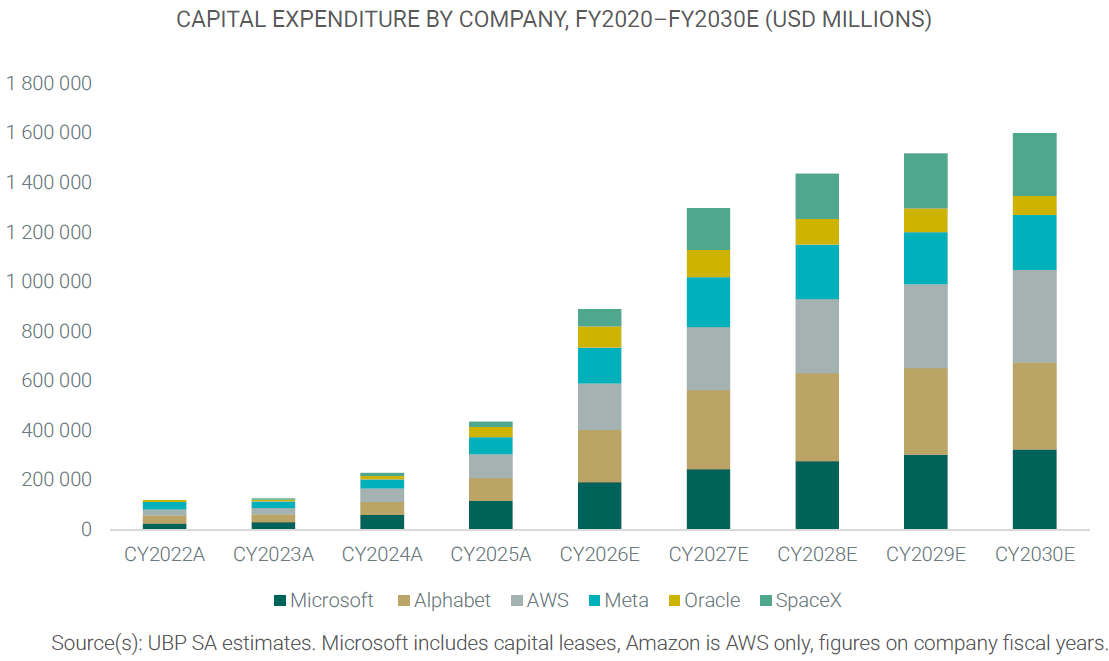
Name by name, the shortfalls compound. Amazon’s gap is about USD 33 billion this year, Meta’s cash flow turns negative, and Oracle’s free cash flow was minus USD 24 billion in FY26. Microsoft is the only one still funding the build-out from internal cash flow, and it is about a year behind the others. Against these gaps stand earnings growing by about 20% a year, cash balances of several hundred billion dollars, the equity Oracle and Alphabet have already sold, and more than USD 600 billion of stakes in OpenAI, Anthropic and SpaceX that could be monetised.
The nearer frame, on Morgan Stanley’s May estimate and so before its own summer capex upgrades, is USD 3.2 trillion of data centre capital spending over 2026–28, of which the credit markets are expected to supply USD 1.75 trillion (Morgan Stanley). The longer one is USD 5.5 trillion through 2030 with USD 4.1 trillion of it being debt (JP Morgan). Either way, most of the money is borrowed.
In the first half of the year the six hyperscaler names accounted for roughly 13% of all US IG issuance and about 30% of the issuance by non-financial companies outside utilities, which are shares never seen for a single industry outside banking pre-global financial crisis (GFC). However, the unsecured bond was only the first market to be opened. Nine channels are now carrying the load, each suited to a different piece of the asset and each carrying a different risk.
IG bonds in dollars remain the workhorse. Amazon issued USD 37 billion in March and USD 25 billion in July, Oracle and Meta USD 25 billion each, and Alphabet USD 20 billion, which came back in August for a further USD 25 billion. Across the technology sector as a whole, including USD 25 billion deals from Nvidia and SpaceX, USD IG issuance reached a record USD 247 billion by mid-July, against an expected full-year record for US IG of USD 2.25 trillion. Jumbo deals of USD 25 billion or more used to be an event, but this year six out of seven were AI-related.

Bonds in other currencies are the second channel and the fastest-growing. The hyperscalers raised USD 62 billion in euros, Swiss francs, sterling, Canadian dollars and yen – four times the amounts they raised abroad in the whole of 2025 – with dollar issuance falling to 63% of their global total from 86%. Most of those markets had almost no exposure to these issuers, so the demand is additive rather than borrowed from the dollar market, and it relieves the pressure on dollar spreads.

Project finance moves the debt off the parents’ balance sheet. A developer or a special purpose company owns and builds the site, the hyperscaler signs a long lease or take-or-pay contract as anchor or sole tenant, the project borrows against that contract and the building rather than the tenant’s balance sheet. The bonds clear at IG because the cash flows are ultimately the contractual obligation of a highly rated tenant and they carry higher yields than that tenant’s own bonds because the structure is newer, the collateral is a single asset, and the investor base is narrower. Loan-to-cost above 85% sounds aggressive until one notices that a leased and powered data centre is worth well above its build cost. Meta’s Louisiana and Texas ventures with Blue Owl and BlackRock are the template.
High-yield (HY) and leveraged loans finance the neoclouds and the developers who cannot borrow at IG. In 2026 they are expected to raise USD 65 billion in HY bonds and USD 15 billion in loans, and USD 350 billion over 2026–30, peaking in 2027. The subsector will be around 4.5% of the HY index by year-end versus negligible just eighteen months ago. CoreWeave’s USD 3.1 billion loan in May, secured on chips and contracts with OpenAI and Cohere, was the first such loan sold to the leveraged-loan market.
Securitisation takes the finished, leased and powered buildings. The US market had issued USD 11 billion in data centre securitisations by mid-June in commercial-mortgage (CMBS) and asset-backed (ABS) formats, against a full-year target of USD 30–40 billion. The constraint is size: the largest data centre CMBS to date was USD 3.2 billion, while a single 1 GW campus would need USD 10–15 billion from this source. Investors here underwrite the tenant and the lease, since the residual value of the building is the part they find hardest to price.
Chip financing is the newest channel and, for the next five years, the greatest need. Silicon and servers are about 60% of the cost of a new site, and public markets have financed almost none of it. CoreWeave’s term loans show the cost falling as the structures mature: its first, in 2023, paid more than nine points over SOFR, while the fourth, in March, paid 2.25 points and was rated A3 – the first IG rating for debt secured on computing hardware. Broadcom’s AI XPV vehicle, which buys the TPUs it makes for Alphabet and leases them to Anthropic, is the other template, and it is the USD 29 billion Broadcom backstop that lifts most of the notes into IG territory. The difficulty is duration: whatever a chip’s true life, it is not ten or thirty years, and the three- and five-year issuance buckets represent only 43% of the IG market, so the buyers who want this paper are a fraction of the market that needs to fund it.
Private credit takes what the syndicated markets find too bespoke: construction loans, sale-leasebacks, and the assets not yet stable enough to securitise. Morgan Stanley’s May estimate had USD 700 billion of the USD 1.75 trillion the credit markets are set to supply over 2026–28 coming from private lenders, USD 500 billion of it asset-backed. Apollo is the template, providing IG-rated private credit at a scale and complexity the public markets will not price. The same managers also arrive as owners as well as lenders through the joint ventures covered in Chapter 8, and they regard both as a multi-decade opportunity.
Delayed-draw term loans and commercial paper sit at hyperscaler level too. Amazon arranged a USD 17.5 billion three-year facility this year, committed now and drawn as the spending arrives, which is cheaper than issuing a bond and holding the cash. Microsoft has done the opposite, funding from commercial paper and its own balance sheet.
Equity has returned to the toolkit. Alphabet announced it would raise USD 90 billion, 63% of everything it had raised by mid-year, while Oracle issued USD 5 billion of mandatory convertible preferred and opened a USD 20 billion at-the-market programme behind it and SpaceX raised USD 86 billion in its June IPO. Then there is Anthropic, which is rumoured to raise at least a similar amount to SpaceX, with a potential listing in October. All in, equity was about 35% of the capital the hyperscalers raised in the first half of the year, and Meta and Amazon are the next obvious candidates. The willingness to sell shares alongside bonds says management sees this as a balance-sheet-defining event rather than a cyclical spending cycle.
Why do the issuers keep coming back despite wider spreads? Because for every one of them the cost of debt remains below the cost of equity, and borrowing lowers the average cost of capital. The widening is also smaller than it sounds. Spreads are a fraction of the all-in yield on these bonds, so a 20 bps move on a 5.5% coupon changes very little for a treasurer. Spreads have moved, but not enough to constrain issuance.
Read more by downloading our latest UBP Headlines
The opinions expressed herein are correct as at 16 September 2026 and are subject to change without notice. This information should not be relied upon by the reader as research or investment advice regarding any particular fund, strategy or security. Past performance is not a guide to current or future results. Any forecast, projection or target, where provided, is indicative only and is not guaranteed in any way.