At the start of the year, we built our investment convictions around two primary forces reshaping the economy: the ongoing reset of the global geopolitical order and the strategic race for dominance in artificial intelligence (AI).
Both trends have materialised, albeit against a more complex backdrop than anticipated; the conflict in Iran – an unforeseen geopolitical development – has disrupted what we had expected to be a broadly favourable trajectory.
While we had anticipated interest rate cuts from major central banks, rising oil prices triggered an inflation shock, followed by a sharp rise in bond yields, with US 10-year Treasury yields reaching their highest levels since 2007 in the autumn. Market performances subsequently diverged significantly: the technology sector benefited from exceptional earnings growth fuelled by AI-related investment, while sectors sensitive to interest rates and energy costs came under pressure. Gold, one of our key investment convictions at the start of the year, experienced a correction that we consider a natural response to higher interest rates and we remain constructive on its outlook.
We are now assessing the implications of this shock. While 2026 had initially been expected to be a favourable year, 2027 is likely to require greater selectivity, with several uncertainties remaining: oil prices, directly influenced by geopolitical developments; the shape of the yield curve; central bank policies; and the sustainability of AI-driven momentum. Against this backdrop, we are avoiding significant directional bets while remaining invested to benefit from growth fundamentals that remain positive across many regions. This approach also provides us with the flexibility to capture tactical opportunities as visibility improves.
Key messages
1. No directional bets: an outlook driven by two forces
Energy prices and the AI cycle are pulling markets in opposite directions and the outcome of each remains uncertain. We are avoiding any pronounced directional views and favour strategies able to navigate contrasting environments, with volatility likely to stay elevated.
2. Oil higher for longer
The Democratic sweep in the US midterm elections has eroded oil’s war premium, but we see no near-term resolution to the Iran conflict, and supply risks are rising ahead of winter. We have raised our Brent crude forecast to USD 90–120 per barrel.
3. Technology: more fragile, but still a driver
AI’s financing concerns have weakened the sector and fuelled the recent sell-off, but earnings expectations remain intact and valuations are near 10-year lows on a relative basis.
4. High yield: attractive carry and a resilient cushion
Yields above 8% in dollars, low default rates and robust nominal growth make high yield attractive and we prefer it to bank-related credit while French public finances remain under pressure.
Our investment stance
Against investors’ expectations, the Democrats’ sweep in the US midterm elections has triggered concerns about the build-out of AI capacity and weighed on energy prices as oil’s war premium faded on lower risks of military intervention in the Gulf. However, we see no sign of a near-term resolution to the Iran conflict, and supply risks are rising ahead of winter in the world’s largest economies, so we have raised our Brent crude forecast to USD 90–120 per barrel. The AI hypothesis remains supportive over the medium term, but risks continue to grow over the payback of trillions of dollars of investment, rising equity dilution at major US tech companies, and circular financing among AI players. Combined with higher global interest rates and European political uncertainty, this leaves the short-term investment environment weaker.
In fixed income, we are maintaining our US 10-year interest rate range of 4.75–5.25% and we are keeping duration neutral at 4 years in all currencies. In credit, spreads widened across the board and French public finances have become a source of stress. As AT1 spreads remain tight and we see no improvement until the French presidential elections in April 2027, we are cautious about AT1s and favour the high yield segment, where yields above 8% in dollars, low default rates and robust nominal growth remain attractive.
In equities, concerns are growing over the scale of capital being deployed into the AI build-out, while the potential for cost savings and monetisation remains unclear. US political developments have accelerated the sell-off, but the administration is unlikely to slow the AI race materially. With the technology sector looking slightly more fragile and few compelling investment cases outside US equities, we are keeping part of our portfolios uninvested for now.
We remain cautious on European equities, as 70% of expected 2027 earnings growth comes from cyclical sectors. That said, a de-escalation in the Middle East or in the Russia–Ukraine conflict could support short-term outperformance. We are also cautious regarding Chinese equities: China has posted the weakest earnings growth among major regions since the pandemic, and we expect Beijing’s recent support measures to be insufficient to create meaningful upside. Conversely, we see opportunities in the energy sector, as the recent correction offers entry points in a ‘higher-for-longer’ energy price scenario.
Elsewhere, gold remains a core allocation and portfolio hedge, and we see its recent correction as being largely flow-driven. Meanwhile, our alternatives exposure through QIS strategies has navigated the more volatile environment well.
Overall, we maintain our scenario of higher-for-longer oil prices and interest rates, alongside an AI cycle that remains supportive but is increasingly coming under scrutiny. This should keep volatility elevated, which will also require more agility to take advantage of tactical opportunities.
The conversations that matter
Could France’s fiscal challenges trigger broader contagion across European sovereign bond markets, and how might the ECB respond?
The 10-year yield spread between Germany and other European countries has indeed widened, but most European government bond (EGB) spreads did not overreact to the widening of the OAT–Bund spread. This indicates that the risks remain largely idiosyncratic to France, with Belgium being the main exception. The breakdown of the 10-year yield change reinforces this conclusion: most of the rise in 10-year OAT yields reflects France-specific factors (+68 bps), while the broader move across the EGB universe accounts for only about 20 bps. To a lesser extent, markets have also discriminated against core vs. periphery countries, with France failing to benefit from its core status.
Even if any contagion remains limited, markets are questioning how the ECB would react if spreads widened further. It has two options: the first is to slow the pace of quantitative tightening (QT), the logic being that tightening already delivered through higher long-term yields has gone further than the ECB considers necessary. However, France’s sizeable budget deficits mean that QT accounts for a relatively small share of the net supply private investors must absorb, dampening the potential benefit of a QT pause for French yields. The second possibility is to activate the Transmission Protection Instrument (TPI), which allows the ECB to purchase potentially unlimited amounts of euro-area government bonds if it judges that market movements are impairing monetary policy transmission and are not justified by economic fundamentals.
That condition is crucial. The recent widening of the OAT–Bund spread appears, at least in part, to reflect France’s weak fiscal fundamentals, which should make the ECB reluctant to intervene. A more forceful response would probably require a further widening of the spread, accompanied by evidence that market dynamics had become disorderly or could no longer be explained by fundamentals.
Is the recent tech sell-off merely a healthy correction, or does it signal the beginning of a structural rotation away from US mega-cap technology stocks?
The recent sell-off reflects growing concerns over AI monetisation, financing and regulation. While we acknowledge these risks, we believe the market reaction has been excessive, as fundamentals remain robust, with S&P 500 Information Technology earnings expected to grow 39% y/y in 2027. Regulatory scrutiny is likely to intensify following the US midterm elections, particularly in states such as Texas, however, outright bans on data centres appear unlikely given their importance to US economic growth and the strategic imperative to maintain America’s AI leadership over China.
Financing conditions will remain challenging, particularly for neoclouds, to the benefit of well-capitalised hyperscalers such as Microsoft, Alphabet and Amazon, which retain access to debt and equity markets.
Anthropic’s anticipated November IPO remains a key catalyst for the AI trade. A successful capital raise, accompanied by reassuring medium-term revenue and profitability guidance, could ease concerns over AI monetisation and financing, particularly if Anthropic demonstrates its ability to sustain strong growth and meet its substantial cloud infrastructure commitments.
Could the Democrats’ midterm victory accelerate a peace process with Iran and trigger a repricing of oil prices and energy stocks?
Democratic control of the House raises the political cost of the Iran war, but we do not expect a quick resolution as a result. We see the current sell-off in oil and energy equities as an overreaction and maintain our 4/5 conviction rating on both oil and the energy sector.
Congress has fewer levers than the markets assumed. Its strongest tool – funding approval – cannot stop operations that have already been financed, including the regular defence budget and military funding that has already been allocated. The president keeps constitutional command authority and can veto any funding cut-offs or restrictions. Overriding a veto would take 290 House and 67 Senate votes, a majority the Democrats do not have. The war is more likely to end through diplomacy or military developments than through legislation.
The two sides also remain far apart, with Iran demanding control of the Strait of Hormuz, that frozen funds be released and that the blockade be lifted, while the US is demanding nuclear concessions. Attacks on shipping and infrastructure continue, and the risk of escalation until the year end cannot yet be ruled out.
Fundamentals also support ‘higher-for-longer’ energy prices. Gulf crude oil exports have largely recovered despite remaining erratic. However, freight costs, military escorts and insurance premiums are keeping prices elevated. More than 400 million barrels of oil have been released from strategic reserves since February and commercial stocks have been depleted, thus creating further demand, as these must be replaced. Refined products, namely diesel and gasoil, and gas are the tightest link, with restricted exports from the Middle East and Russia, reduced global refining capacity, and low European gas inventories leaving the continent exposed this winter.
A credible de-escalation, or a funding stand-off next year, could briefly push crude prices towards USD 80/bbl, and these are the two short-term risks we are monitoring, however, we expect any such pullback to be temporary. Absent demand destruction, energy security and seasonal demand drivers will keep prices elevated once the political noise fades and depleted inventories are rebuilt. Until then, we see the weakness as an entry point and remain positive on quality energy equities.
Macroeconomics
Global growth facing major global uncertainties
US growth and investment to remain sustained
Global growth is expected to remain resilient at close to 3% in both 2026 and 2027. However, uncertainty has continued to increase, while visibility on the economic cycle remains limited due to oil-market tensions and political and geopolitical risks.
The US and Asia are still expected to outperform, supported by the ongoing investment cycle. The sustainability of this cycle will depend on whether AI investment generates substantial productivity gains during 2028–2030. This appears to be the case in sectors that have already adopted AI, although adoption and expansion remain far from broad-based across the US and other economies.
The US outlook combines significant strengths and vulnerabilities. Strong investment, resilient domestic demand, and continued policy support are sustaining economic activity. However, the economy remains characterised by a K-shaped consumption pattern and a technology-driven boom. Nevertheless, US growth is expected to remain within a range of 2.0–2.5% in 2026–2027.
The US midterm election results, with Congress now dominated by Democrats, could lead to political gridlock, limiting new spending initiatives by both the White House and Congress, apart from a necessary agreement on the debt ceiling. Nevertheless, both parties will probably converge on maintaining the positive economic momentum and current growth trend, even if some rebalancing occurs across sectors (health, energy, AI). President Trump’s ability to act may be constrained by a hostile Congress, but he can still influence trade policy and geopolitics. The development of the conflict in the Middle East and the extent of US involvement in Iran remain uncertain following the change in the congressional majority.
Global activity remains fragmented, as growth in Europe and Japan is expected to remain limited at close to 1%; these economies remain vulnerable as long as pressure on oil & gas prices persists. Moreover, social unrest in France ahead of the country’s next presidential election, combined with a budgetary deadlock, could generate additional downside risks to the 2027 outlook. In an environment of higher-for-longer oil & gas prices, rising interest rates, and heightened political risks, the eurozone outlook risks being revised sharply downwards to just 0.5%, pointing to increasing stagflation risks. In such a scenario – which is not our base case – French growth could be flat, rather than the 0.5% currently estimated for 2027. Nevertheless, France is not close to a Greece-style crisis; the euro area now has more tools at its disposal to prevent a systemic crisis and contain fragmentation risks than it did in 2010–2015.
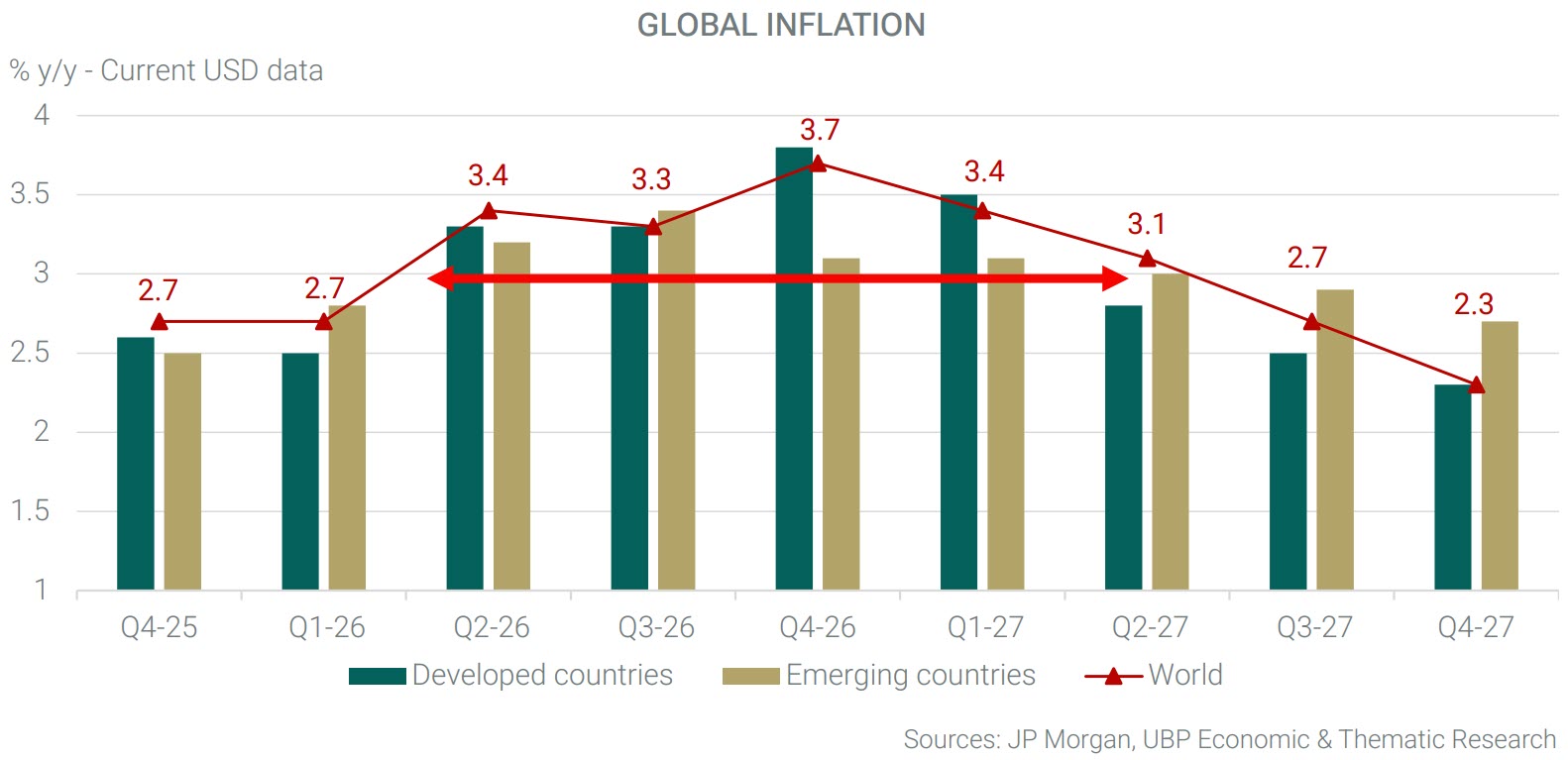
Higher inflation expected over the next six months
Inflation is expected to remain elevated over the coming quarters. Further peaks are possible during the winter, as oil prices remain volatile and subject to upside risks. Inflation is likely to remain well above central bank targets across all major regions over the coming months and throughout the first half of 2027. Global inflation is not expected to return to a more normal range of 2.0–2.5% before the fourth quarter of 2027 or the beginning of 2028.
Energy prices remain the main near-term risk. A continued conflict in the Middle East could transmit higher energy costs – including Brent crude prices at close to USD 120 per barrel – to core goods and services. This risk would be particularly significant if firms pass rising commodity, raw material, transportation, and labour costs on to consumers.
These pressures are likely to be most pronounced in the US, where demand remains resilient, although global spillovers have so far been limited. US inflation is expected to rebound to more than 4% y/y over the coming months; core personal consumption expenditures (PCE) inflation should remain close to 3%, while core consumer price index (CPI) inflation could also approach 3% y/y.
Food-price pressures could also intensify as a result of the effects of El Niño. These pressures initially affected emerging economies but are now becoming a concern for developed markets as well. Together, energy- and food-price pressures could keep headline inflation elevated while increasing the risk of a renewed rise in core inflation. Eurozone inflation is expected to reach new highs, exceeding 4% y/y under the combined impact of food and energy prices, as well as persistent services inflation.
A tighter monetary regime amid continued fiscal spending
Central banks have shifted from a neutral or accommodative stance at the beginning of 2026 towards a moderately restrictive policy stance, accompanied by more hawkish communications generally. Financial conditions have tightened in the major economies, although not yet dramatically. Policymakers are generally seeking to position interest rates at, or slightly above, their respective neutral levels.
According to our scenario, following several central banks’ wait-and-see stance in October, further gradual rate increases could be put in place during the fourth quarter of 2026 or the first quarter of 2027. However, the pace and magnitude of these increases will differ across central banks, depending on domestic conditions.
The US Federal Reserve is expected to raise its policy rate to 4.25% in December, with a possible further increase to 4.50% in the first quarter of 2027 if demand and core inflation remain strong. The European Central Bank (ECB), whose rate currently stands at 2.50%, could raise it to 2.75% if energy prices continue to rise. At the ECB’s latest meeting, Christine Lagarde indicated that the ‘direction of travel [on rates] is clear’. The Bank of England (BoE) began its tightening cycle in early November with a 25-bp hike to 4.00% and may raise rates once more to a terminal level of 4.25%. No reversal of this global tightening cycle is expected before oil prices and geopolitical conditions stabilise.
If inflationary risks persist, 2027 will see central banks having to choose between controlling inflation by cooling domestic demand more severely – particularly in the US – or accepting inflation remaining close to 3% over the medium term.
Fiscal policy generally remains supportive, with high deficits and rising public debt across all major economies in 2026, a trend that is expected to continue in 2027. In some countries, fiscal support has been reactivated to mitigate the energy shock affecting various sectors. However, and particularly in the eurozone, this support comes at the cost of larger deficits, fuelling concerns about sovereign risk and debt sustainability.
How to get the full version of the UBP House View:
- Private clients: Please contact your relationship manager
- Institutional clients: Please contact your institutional representative
- All users: Subscribe to our UBP House View newsletter (fill out the form below and check the box "UBP House View")
The financial instruments and investment strategies portrayed in this document are for informative purposes only. They may differ from those effectively held in an investor’ portfolio. Depending on the jurisdiction and investment profile, one or some of these instruments and strategies – including, where applicable, options – may not be permitted, available or suitable. The opinions expressed herein are correct as at 11 November 2026 and are subject to change without notice. Any forecast, projection or target, where provided, is indicative only and is not guaranteed in any way.