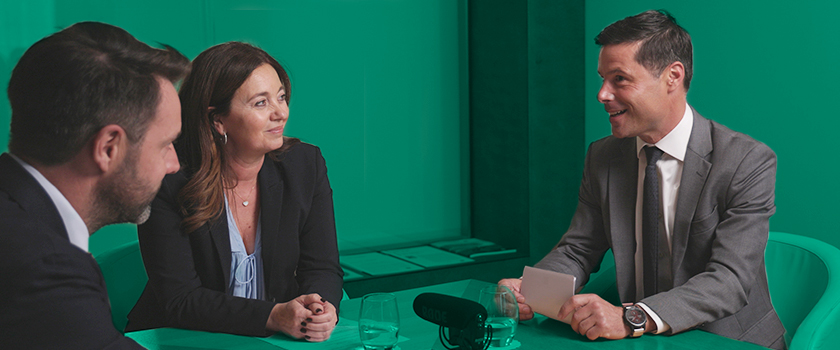
Over the past decade, the Middle East has evolved from a region primarily associated with energy resources into a sophisticated hub for global capital and private investment.
Over the past decade, the Middle East has undergone a financial and socio-economic transformation. It has – in a relatively short space of time - evolved from a region primarily associated with energy resources into a sophisticated hub for global capital and private investment. Conversely, many developed nations have seen their economic growth and productivity slow down, while taxes rise.
Long-term planning and regulatory reforms partly explain why the Middle East is doing so well. Structural reforms, progressive regulations, and national strategies such as Saudi Arabia’s Vision 2030 and the UAE’s economic diversification initiatives have positioned centres like Dubai and Riyadh at the core of international wealth flows. Naturally, this evolution has helped to facilitate capital attraction – particularly with some developed economies experiencing a flight of wealth. This is neatly explained in the Henley Private Wealth Migration Report 2025 , which reflects on the United Kingdom’s projected loss of 16,500 millionaires in 2025. The report indicates that the UAE is projected to experience a net inflow of 9,800 high-net-worth individuals (HNWIs) in 2025, while Saudi Arabia anticipates 2,400, many of whom are arriving from the UK.
The Middle East’s success is not, however, just a happy by-product of economic misfortunes in other parts of the world. The region’s emergence as a global centre of capital is underpinned by three key trends: the influx of global wealth, the maturation of local wealth management ecosystems, and an enhanced global influence through capital deployment. Policies promoting tax efficiencies and residency programs, combined with connectivity to emerging markets in Asia, Europe, and Africa, have created an environment conducive to capital growth.
Stability and long-term planning
The region has a culture of large, multi-generational, independent family businesses. Succession planning is, therefore, an integral wealth management service in the Middle East to ensure smooth handovers. Effective succession planning enables families and high-net-worth individuals in the region, and those entering the region who are starting and running businesses here, to preserve their legacies while developing strategies for capital deployment and growth.
The region has a culture of large, multi-generational, independent family businesses. Succession planning is, therefore, an integral wealth management service in the Middle East to ensure smooth handovers.
The influx of global wealth (the World Economic Forum reports that the UAE achieved a net inflow of 6,700 HNWIs in 2024) is driven by a myriad of factors. Investors, family offices, and entrepreneurs are selecting GCC countries for residency and capital deployment, attracted by geopolitical stability, zero personal income tax in the UAE, and strategic access to high-growth markets. Dubai and Riyadh provide integrated business ecosystems - such as Dubai’s TECOM Group, which offers ten industry-specific business districts across six economic sectors. There is also the lifestyle pull. For families, schools are excellent, the quality of real estate is world-class, and crime is low.
Wealth management ecosystems
The second trend involves the maturation of local wealth management ecosystems, supported by highly advanced digital infrastructure and business and wealth advisory services. Regional financial institutions have advanced to offer advisory, investment, and private banking services tailored to high-net-worth clients. Initiatives such as Saudi Arabia’s Financial Sector Development Program have improved efficiency and transparency. Many of these systems incorporate technology for bespoke solutions, with capital deployment, wealth management and succession planning as core components for family governance during periods of wealth expansion.
The 2025 EY Global Wealth Research Report highlights the GCC’s adaptation toward greater agility and technology integration to meet investor expectations - including for AI-enhanced insights. Mordor Intelligence forecasts the MENA wealth management market to expand from $1.25 trillion in 2024 to $1.78 trillion by 2029, at a compound annual growth rate of approximately 7%.
Global capital deployment
The third trend is the region’s expanding global influence through outward capital deployment.
Sovereign wealth funds, private investors, and entrepreneurs are deploying capital internationally, gaining more soft power around the globe. Analysis from Deloitte highlights that Gulf Sovereign Wealth Funds are leading global growth, with their assets forecast to reach $18 trillion by 2030.
This outward flow positions the Middle East as a major financier of the world, enhancing its geopolitical and economic influence on the global stage. As such, the GCC’s capital is increasingly contributing to a shifting world order. Furthermore, with increased Middle Eastern ownership of assets around the world, from stakes in major tech firms to infrastructure projects, the region is achieving ever-greater sway in international decision-making.
The sums of capital being deployed regionally and globally make it clear that the Middle East’s financial prominence represents a lasting reconfiguration of global capital. These trends are powerful, strategic and historic: ecosystem development, highly focused national economic strategies that are attracting inward investment, and outward deployment. Collectively, these dynamics position the region to benefit from every conceivable opportunity in an uncertain world.
As the world’s centres of economic gravity shift, wealth management in the 21st century is being rewritten, establishing the region as a benchmark for harmonising growth with continuity. High-Net-Worth individuals, investors and families must engage specialised partners to craft strategies that safeguard legacies and take advantage of the many opportunities that are unique to the GCC region. We indeed live in uncertain times, and our world is in a state of flux – but the Middle East’s hard-earned place as the new centre of capital is likely to be a permanent fixture.
.webp)